A business tax calculator helps you estimate your total federal, state, and self-employment tax liability based on the legal structure of your company. Earning $150,000 in net profit sounds great — until you realize your entity type alone can swing your tax bill by $5,000 to $15,000 per year. A sole proprietor pays 15.3% SE tax on nearly every dollar of profit, while an S Corp owner only pays payroll tax on a reasonable salary. A C Corp faces a flat 21% corporate rate but triggers double taxation when distributing dividends. Understanding these differences before you file is the single most impactful tax decision a small business owner can make.
This article walks through how each entity type is taxed, shows a worked example on $150,000 profit, highlights the key factors that affect your results, and covers the most common mistakes business owners make when choosing a structure. Use the calculator above to model your own numbers, then read on to understand why the results differ.
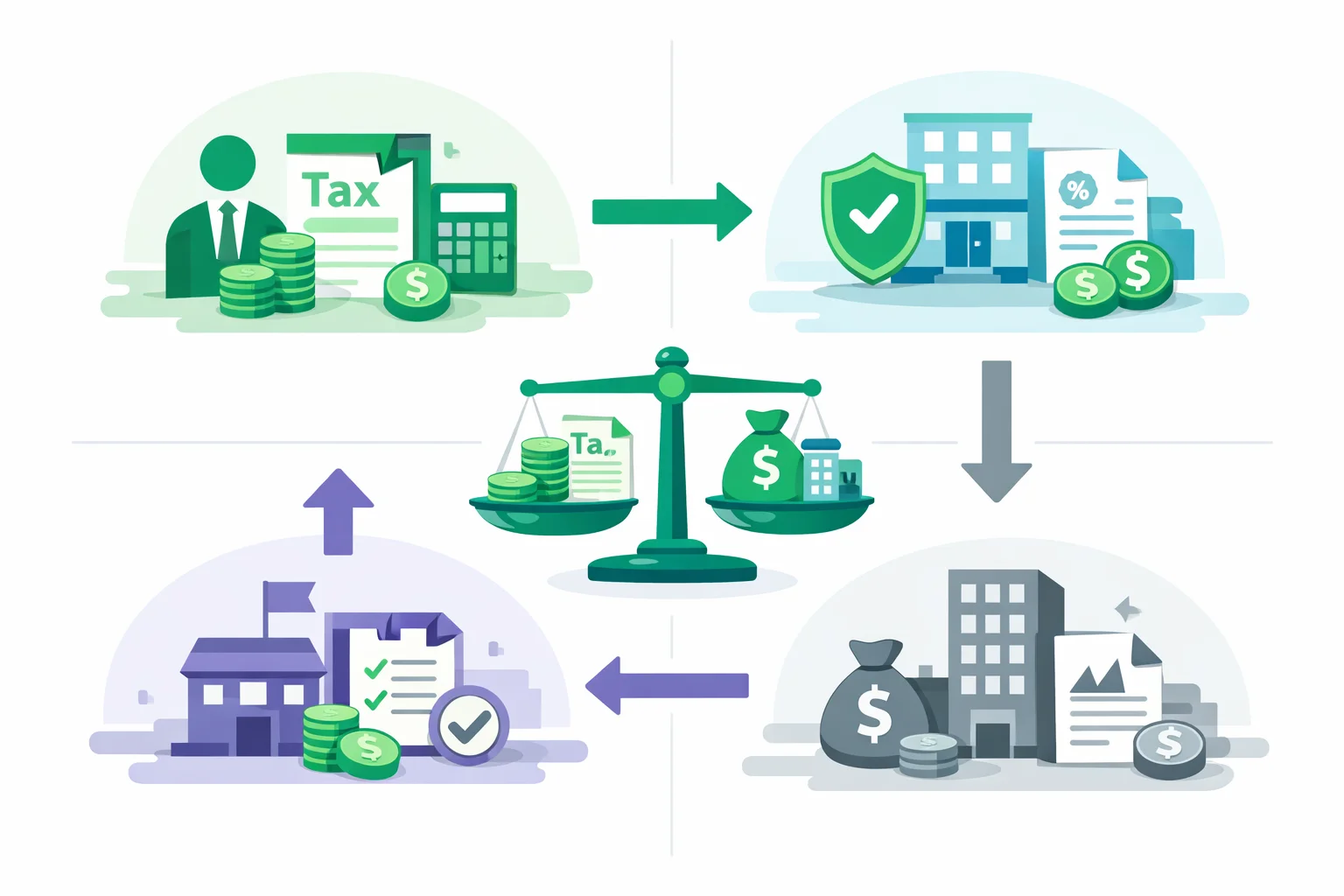
How Business Taxes Work by Entity Type
The IRS does not tax "businesses" uniformly. Your legal structure determines which tax forms you file, how profits are taxed, and whether you pay self-employment tax. Here is how each of the four main structures works in practice for a single owner earning $150,000 net profit with no other income, filing single in 2025.
Sole Proprietorship (Schedule C)
All net profit flows directly to your personal Form 1040 via Schedule C. You owe self-employment tax (Social Security + Medicare) on 92.35% of your net profit, plus federal income tax on the remainder after deductions. There is no separation between you and the business — simple to set up, but the most expensive in SE taxes for profitable businesses.
Single-Member LLC (Disregarded Entity)
A single-member LLC is ignored for federal tax purposes. You file the same Schedule C as a sole proprietor and pay the same SE tax. The LLC provides liability protection but zero tax advantage by default. However, an LLC can elect S Corp or C Corp taxation by filing Form 2553 or Form 8832, which is why most CPAs recommend forming an LLC first and electing the tax treatment separately. Run the numbers for your situation with our LLC tax calculator to see exactly how each election changes your bottom line.
S Corporation (Form 1120S)
An S Corp is a pass-through entity. Profits flow to your personal return, but with a key advantage: you split your income into a W-2 salary (subject to payroll tax) and a distribution (not subject to SE tax). On $150,000 profit with a $70,000 reasonable salary, only $70,000 faces payroll tax instead of the full $150,000. That difference saves roughly $7,000–$9,000 per year in self-employment tax alone. The trade-off is administrative overhead — you must run payroll, file Form 1120S, and maintain a "reasonable" salary that the IRS won't challenge.
C Corporation (Form 1120)
A C Corp is a separate tax entity. The corporation pays a flat 21% tax on profits, then any remaining profit distributed as dividends gets taxed again on your personal return at the qualified dividend rate (0%, 15%, or 20%). This "double taxation" sounds bad, but at high income levels, the 21% corporate rate can be lower than the 32%–37% individual brackets. C Corps make the most sense when you plan to retain significant earnings inside the company rather than distributing everything as dividends.
Worked Example: $150,000 Net Profit, Single Filer, 5% State Tax
We've found the best way to understand entity selection is to run the same scenario through all four structures. Here is $150,000 net profit with a $70,000 S Corp salary, $80,000 C Corp salary, 5% state tax rate, and no other income.
| Tax Component | Sole Prop | LLC | S Corp | C Corp |
|---|---|---|---|---|
| SE / Payroll Tax | $21,194 | $21,194 | $10,710 | $12,240 |
| Federal Income Tax | $16,248 | $16,248 | $18,580 | $10,528 |
| Corporate Tax (21%) | — | — | — | $12,458 |
| Dividend Tax | — | — | — | $7,023 |
| State Tax (5%) | $7,500 | $7,500 | $7,157 | $11,079 |
| Total Tax | $44,942 | $44,942 | $36,447 | $53,328 |
| Take-Home Pay | $105,058 | $105,058 | $113,553 | $96,672 |
In this scenario, the S Corp saves $8,495 per year compared to a sole proprietorship and $16,881 compared to a C Corp. The S Corp wins because it avoids SE tax on $80,000 of distributions while still qualifying for the 20% QBI deduction. The C Corp loses here because double taxation (corporate tax + dividend tax) eats into the benefit of the lower corporate rate. Use our S Corp tax calculator for a deeper dive on the S Corp salary split.
Key Factors That Affect Your Entity Selection
No single entity type is universally "best." Five factors determine which structure saves the most tax in your specific situation. Adjusting any one of these can shift the winner entirely.
- Net profit level. Below $40,000–$50,000 in net profit, the S Corp's payroll and filing costs ($1,500–$3,000/year) typically exceed its SE tax savings. Above $250,000, the C Corp's flat 21% rate starts competing with the 32%–37% individual brackets.
- Reasonable salary percentage. Setting an S Corp salary at 40% of profit saves more SE tax than 60%, but an artificially low salary increases IRS audit risk. Most CPAs recommend the 40%–60% range based on industry norms.
- State tax rate. Moving from a 0% state (Texas, Florida) to a 13.3% state (California) adds $15,000–$20,000 in tax on $150,000 profit. Use our state income tax calculator to model your state's exact impact.
- Profit retention plans. If you plan to reinvest most profits inside the business rather than distribute them, a C Corp's 21% rate on retained earnings beats the 24%–37% individual rates. Accountants typically recommend C Corps for businesses retaining $100,000+ annually.
- Filing status and other income. Married Filing Jointly doubles the standard deduction and widens every bracket, which can reduce the tax gap between entity types by $2,000–$5,000. Other W-2 income pushes your marginal rate higher, making the S Corp even more valuable.
Common Mistakes Business Owners Make
We've seen these errors cost business owners thousands of dollars per year. Most are easy to avoid once you understand the rules.
- Ignoring the S Corp election when profit exceeds $50,000. A sole proprietor earning $100,000 net profit pays roughly $14,130 in SE tax. An S Corp with a $50,000 salary pays about $7,650 in payroll tax — that's $6,480 left on the table every year.
- Setting an unreasonably low S Corp salary. Paying yourself $20,000 on $150,000 profit is a red flag. The IRS reclassifies distributions as wages in audits, resulting in back taxes, penalties, and interest. Target at least 40% of net profit or the market rate for your role, whichever is higher.
- Choosing a C Corp for pass-through income. Small business owners who distribute all profits as dividends face double taxation with a C Corp. At $150,000 profit, this costs roughly $8,000–$16,000 more than an S Corp. C Corps only make sense when retaining significant earnings.
- Forgetting about QBI deduction eligibility. The 20% Qualified Business Income deduction (Section 199A) applies to sole props, LLCs, and S Corps — but not to C Corp income. At $150,000 profit, that deduction is worth roughly $4,000–$6,000 in tax savings. Switching to a C Corp means losing it entirely.
When Each Entity Type Makes Sense
In practice, most small business owners follow a predictable progression as their income grows. Here is a decision framework based on annual net profit levels.
- Under $50,000 net profit: Stay as a sole proprietor or single-member LLC. The administrative costs of an S Corp ($1,500–$3,000/year) wipe out any tax savings. Focus on growing revenue first.
- $50,000–$150,000 net profit: Elect S Corp taxation. This is the sweet spot where SE tax savings ($4,000–$10,000/year) easily justify the additional filing costs. Use our corporate tax calculator to confirm.
- $150,000–$400,000 net profit: S Corp remains optimal for most pass-through businesses. At the higher end, run the numbers against a C Corp, especially if you retain significant earnings.
- Above $400,000 net profit: Consult a CPA about advanced strategies. Some owners use an S Corp that owns a C Corp, or split operations between entities. The effective tax rate calculator can help you understand your blended rate.
Not sure where you fall? Our business entity comparison calculator runs all four structures simultaneously on your exact income and shows which one wins at your profit level.
Practical Tax-Saving Tips
Beyond choosing the right entity type, these strategies can reduce your tax bill by an additional $2,000–$10,000 per year depending on your situation.
- Max out retirement contributions. An S Corp owner can contribute up to $23,500 as an employee (2025 limit) plus 25% of salary as an employer match. On a $70,000 salary, that's $23,500 + $17,500 = $41,000 in tax-deferred retirement savings. Use our investment growth calculator to project the growth.
- Claim the home office deduction. The simplified method gives you $5/sq ft up to 300 sq ft ($1,500). The actual method often yields $3,000–$5,000 for a dedicated office. Both sole props and S Corp owners can claim this.
- Time your S Corp election correctly. File Form 2553 by March 15 to take effect for the current tax year. Missing this deadline means waiting until the next year — a $5,000–$10,000 mistake for profitable businesses.
- Plan your quarterly estimated payments. Regardless of entity type, most business owners must pay taxes quarterly to avoid IRS underpayment penalties. Use our quarterly business tax calculator to determine exact payment amounts and due dates for your entity structure.
- Track health insurance premiums. S Corp shareholders who own more than 2% can deduct health insurance premiums as an above-the-line adjustment. For a family plan costing $18,000/year, this saves $3,960–$6,660 depending on your marginal bracket. Check your paycheck tax breakdown to see how deductions affect take-home pay.