In investing, you cannot control the market returns, but you can control your costs. The expense ratio is the single most important number that determines the long-term success of your portfolio, yet most investors ignore it. Our Expense Ratio Calculator reveals the startling truth: how a seemingly small fee can erode tens or even hundreds of thousands of dollars from your future wealth.
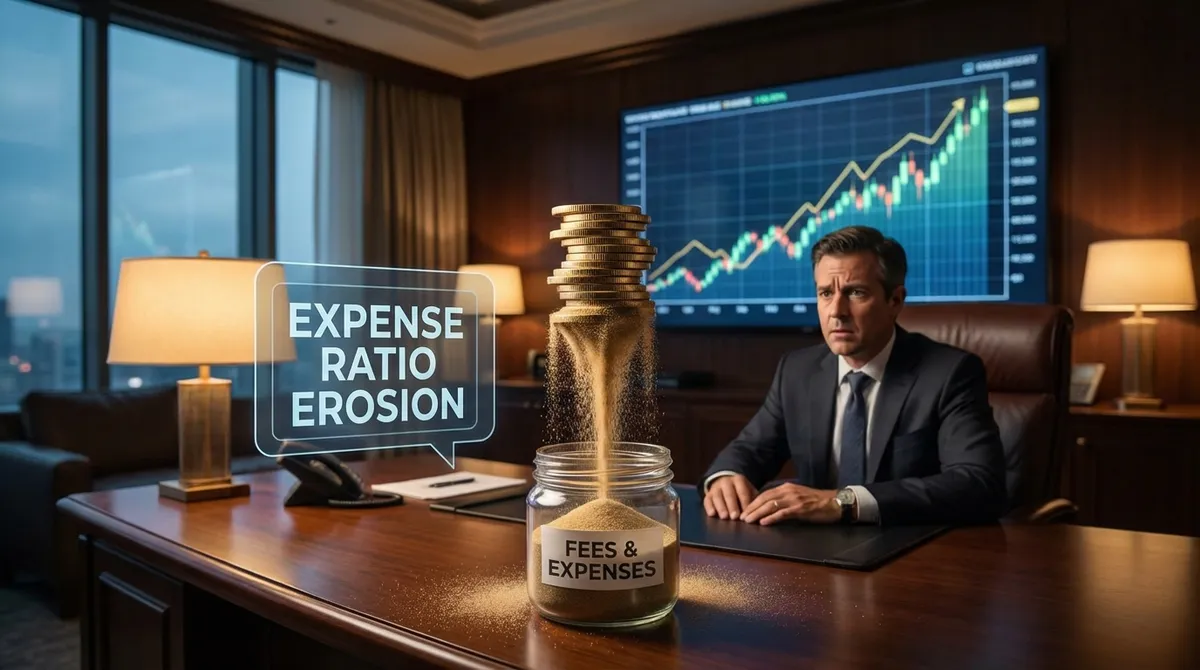
Fees create a drag on your portfolio known as "opportunity cost." Every dollar you pay in fees is a dollar that creates a hole in your compounding snowball. Over 30 years, this hole grows exponentially. Understanding the difference between a 0.05% fee and a 1.00% fee is not just about pennies; it is often the difference between retiring early and working an extra five years.
How to Use This Expense Ratio Calculator
Use this tool to compare two funds (e.g., Fund A vs Fund B) or to simply see the true cost of the fees you are paying today.
1. Initial Investment
Enter the amount of money you have invested today.
Scenario: Even if you are starting from zero, the calculator will project costs based on your future contributions.
2. Annual Contribution
How much do you plan to add to the account each year?
Context: Fees are charged on your entire balance, including your new contributions. As your pile of money grows, the absolute dollar amount of the fees grows with it.
3. Annual Return
The expected growth rate of the market before fees.
Assumption: For a fair comparison, assume both funds earn the same gross return (e.g., 7% or 8%). The calculator will then subtract the fee to show the net return.
4. Investment Period
How many years will you hold the investment?
The Compound Effect: The impact of fees is relatively small in year 1 but massive in year 30. This is because you lose the fee plus all the compound growth that fee would have earned had it stayed in your account.
5. Expense Ratio (The Fee)
Enter the expense ratio of the fund.
Benchmarks:
- Passive Index Funds (ETFs): 0.03% to 0.10%. (Excellent)
- Active Mutual Funds: 0.70% to 1.50%. (High)
- Financial Advisor fees: Often add another 1.00% on top.
What is an Expense Ratio?
An expense ratio is an annual fee charged by mutual funds and ETFs to cover operating expenses. It includes:
- Management Fees: Salaries for portfolio managers and analysts.
- Administrative Costs: Record keeping, customer service, and legal costs.
- Marketing (12b-1) Fees: Costs to advertise the fund to new investors.
Crucially, this fee is deducted automatically from the fund's assets. You never receive a bill for it, which makes it invisible to many investors. You simply see a slightly lower return than the market index.
The High Cost of Active Management
Many investors believe that paying higher fees gets them better performance. In most industries (cars, clothes, food), higher price often equals higher quality. In investing, the opposite is true. You get what you don't pay for.
Active vs. Passive
Active Funds employ teams of experts to try to pick winning stocks and beat the market. They charge high fees (typically > 1%) to pay for this expertise. However, data (like the SPIVA report) consistently confirms that 80-90% of active managers underperform their benchmark index over 15-20 years, largely because of these high fees.
Passive Funds (Index Funds) simply use a computer to buy every stock in the index (like the S&P 500). They have virtually no overhead, allowing them to charge tiny fees (e.g., 0.03%). By guaranteed to capture the market return minus a tiny fee, they mathematically outperform the majority of active funds after costs.
The "2% Rule" Warning
Consider a "typical" investment setup where you pay a fund manager 1% and a financial advisor 1%. That is a total fee of 2%.
If the market returns 8%, and you pay 2% in fees, you keep 6%.
Did you lose 2% of your profit? NO.
You lost 2% of the total asset value, which is actually 25% of your profit (2% is one-quarter of 8%).
Over an investment lifetime, giving up 25% of your annual return typically results in giving up 40% to 50% of your total final wealth. This is the "tyranny of compounding costs."
Case Study: The Million Dollar Difference
Let's run a scenario using our calculator:
- Initial Investment: $100,000
- Annual Contribution: $0 (Lump sum only)
- Time Horizon: 30 Years
- Growth Rate: 8%
Fund A (Low Cost Index Fund - 0.05% fee)
Final Value: $993,000
Total Fees Paid: ~$13,000 (Lost Opportunity Cost included)
Fund B (High Cost Mutual Fund - 1.00% fee)
Final Value: $761,000
Total Fees Paid: ~$245,000
Result: That "small" 1% fee cost you over $230,000. That is the price of a small house, gone forever into the pocket of the fund manager.
Hidden Costs Beyond the Expense Ratio
While the expense ratio is the most visible fee, it isn't the only one. The "Total Cost of Ownership" of a fund can be even higher.
Trading Costs (Turnover)
Funds with high turnover (buying and selling stocks frequently) incur transaction costs. These costs are not included in the expense ratio but are deducted from the fund's assets. High turnover also generates short-term capital gains taxes for you in taxable accounts. Index funds have very low turnover; active funds often have high turnover.
Cash Drag
Active managers often hold 5-10% of the portfolio in cash to handle redemptions or wait for buying opportunities. In a bull market, this cash earns zero return (or very little), causing the fund to lag behind a fully invested index fund. This "performance drag" is effectively a hidden cost.
How to Find Lower Cost Funds
If you discover you are paying high fees, how do you find alternatives?
- Look for "Index" in the name: Most low-cost funds explicitly state they are Index Funds.
- Check the Prospectus: Look for the "Fees and Expenses" table. The Gross Expense Ratio should be clearly listed.
- Compare ETFs: ETFs generally have lower expense ratios than their mutual fund counterparts. For example, compare the ETF version of a fund to its mutual fund share class.
- Use a Screener: Brokerage tools allow you to filter funds by "Expense Ratio < 0.10%".
The "Rule of 72" and Investment Fees
The Rule of 72 is a mental math shortcut to estimate how long it takes an investment to double. You divide 72 by your rate of return.
Investment: $10,000 | Market Return: 8%
Scenario A: Low Cost (0.10% fee)
Net Return = 7.9%
Doubling Time: 72 / 7.9 = 9.1 Years
Scenario B: High Cost (2.10% fee)
Net Return = 5.9%
Doubling Time: 72 / 5.9 = 12.2 Years
The Cost of Waiting: The high fees add more than 3 years to your doubling time. Over an investing career, Scenario A might double 4 or 5 times, while Scenario B only doubles 3 times. That is the difference between $160,000 and $80,000.
Typical Expense Ratios by Asset Class (2024 Benchmark)
How do you know if your fund is expensive? Use these benchmarks as a guide. If you are paying more than the "Average Passive" rate, ask yourself why.
| Asset Class | Avg Passive (ETF) | Avg Active (Mutual Fund) | The "Rip-Off" Zone |
|---|---|---|---|
| US Large Cap (S&P 500) | 0.03% - 0.09% | 0.60% - 0.90% | > 1.00% |
| International Stock | 0.07% - 0.15% | 0.80% - 1.20% | > 1.35% |
| US Bonds | 0.04% - 0.10% | 0.50% - 0.80% | > 1.00% |
| Target Date Funds | 0.08% - 0.15% | 0.60% - 0.95% | > 1.00% |
The Fiduciary Standard
Why do high-fee funds still exist if they perform poorly? Often because financial advisors are paid commissions to sell them to you.
When seeking financial advice, always ask if your advisor is a Fiduciary. A fiduciary is legally required to act in your best interest, which typically means recommending low-cost products. A non-fiduciary (broker) is only required to recommend "suitable" products, which often means the product that pays them the highest commission, regardless of its high expense ratio.
The Compound Cost Table
Let's visualize the impact of fees on a $100,000 investment growing at 8% over different time periods.
| Time | 0.05% Fee (Index) | 1.00% Fee (Active) | 2.00% Fee (Advisor) | Extra Cost Paid |
|---|---|---|---|---|
| 10 Years | $215,400 | $196,700 | $179,000 | $36,400 |
| 20 Years | $464,500 | $386,900 | $320,700 | $143,800 |
| 30 Years | $1,005,000 | $761,000 | $574,000 | $431,000 |
The takeaway: In the 30-year scenario with a 2% fee, nearly half of your potential wealth has been transferred from your pocket to the financial industry. Use our calculator to check your own numbers and stop the leak today.
Frequently Asked Questions
Related Calculators
Optimize your portfolio further with these tools:
- Investment Calculator - Project your growth with different contribution levels.
- Dividend Reinvestment Calculator - See the power of compounding dividends.