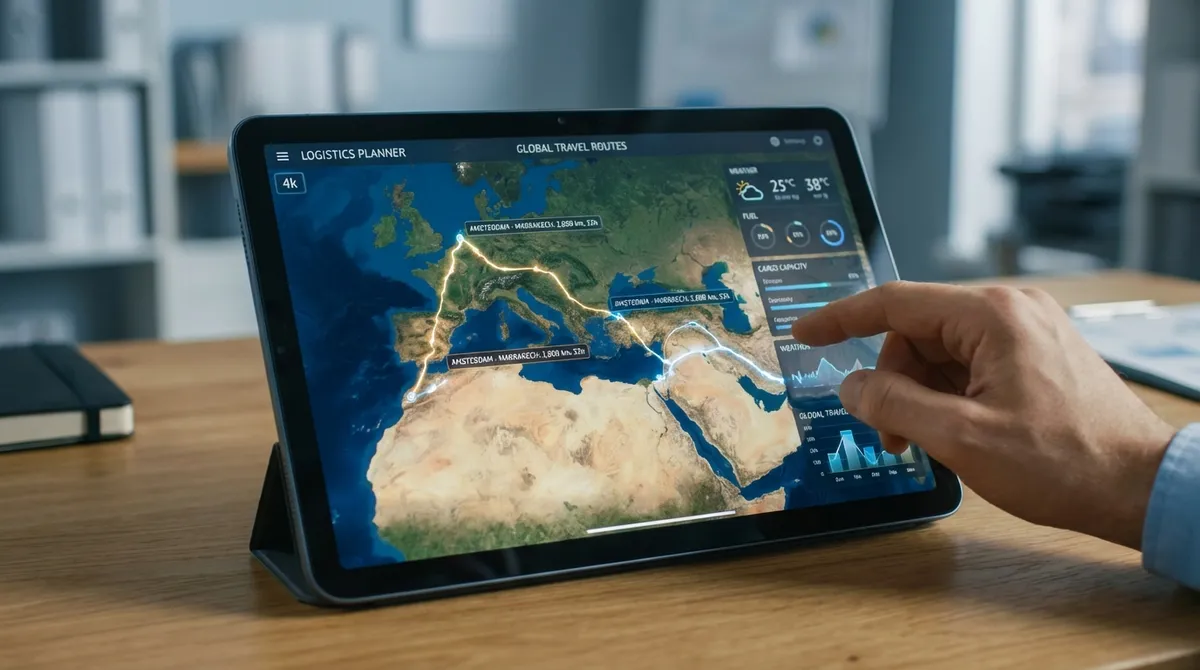
Planning a shipment, road trip, or delivery route requires accurate estimates of distance, time, and cost. Our Map Calculator helps you calculate the direct distance between two points, estimate travel time based on speed, and project fuel costs for effective route planning.
How to Use the Map Calculator
This tool offers three distinct calculators to help with different aspects of logistics and travel planning. Whether you are a logistics manager planning a fleet route or a traveler estimating gas costs, this multi-purpose tool provides the essential data you need.
1. Distance Calculator
Calculate the "as the crow flies" (great-circle) distance between two specific points on the globe using their Latitude and Longitude coordinates. This is particularly useful for air freight estimations or understanding the absolute minimum distance between two locations.
- Enter Coordinates: Input the Latitude and Longitude for Point A (start) and Point B (end).
- Select Unit: Choose between Miles or Kilometers.
- Result: View the direct distance. Note that driving distance is typically longer than this direct line.
2. Route Time Estimator
Estimate how long a trip will take based on distance and your average speed. This feature is crucial for logistics planning, ensuring drivers adhere to schedules, and setting realistic delivery expectations for customers.
- Total Distance: Enter the driving distance (e.g., from a GPS or map app).
- Average Speed: Input your expected average speed, accounting for traffic and stops.
- Result: Get the estimated travel time in hours and minutes.
3. Fuel Cost Estimator
Calculate the projected fuel cost for a trip to budget effectively. With fluctuating fuel prices, knowing the estimated cost of a trip beforehand is essential for profitability analysis in shipping and personal travel budgeting.
- Trip Distance: Enter the total distance of your route.
- Fuel Price: Input the current price of gas or diesel per gallon/liter.
- Efficiency: Enter your vehicle's MPG (Miles Per Gallon) or KPL (Kilometers Per Liter).
- Result: See the total estimated fuel cost and the amount of fuel required.
Understanding Distance Calculations in Logistics
When planning logistics, it's important to distinguish between different types of distance measurements. Accuracy in these figures can mean the difference between profit and loss in thin-margin shipping operations.
Great-Circle Distance (Haversine Formula)
Our calculator uses the Haversine formula to calculate the shortest distance between two points on the surface of a sphere (the Earth). This formula accounts for the curvature of the earth, making it far more accurate than simple planar geometry for long distances. This metric is standard for aviation and maritime shipping where paths can follow the earth's curvature directly.
Formula Note: The Earth is not a perfect sphere (it's an oblate spheroid), so calculation has a small margin of error (approx. 0.3%). For most implementation planning and general estimates, this is negligible.
Driving vs. Direct Distance
Direct distance is a straight line ("as the crow flies"). Driving distance accounts for roads, turns, terrain, and infrastructure. Typically, driving distance is 20% to 40% longer than direct distance depending on the route's complexity (urban vs. rural).
For example, a direct line across a mountain range might be 100 miles, but the driving route could be 150 miles or more due to switchbacks and passes. When estimating driving time or fuel using our Shipping Calculator, always ensure you are using the road distance if available, or add a buffer to your straight-line calculation.
Geodesic vs. Planar Calculations
In the world of mapping, projection matters. For short distances—such as calculating the area of a small property or the distance between two buildings in a city—planar calculations (assuming a flat surface) are sufficient. However, for logistics estimating cross-country or international shipments, assuming the earth is flat leads to significant errors.
Our Map Calculator utilizes Geodesic calculations. This means we treat the earth as the curved surface it is. The shortest path between two points on a sphere is a segment of a "great circle." You can visualize this by stretching a string between two points on a globe; the string will not follow a straight line on a flat map (Mercator projection), but will curve towards the poles. This "Great Circle" path is the most efficient route for airplanes and ships, saving fuel and time.
Optimizing Route Planning and Costs
Effective route planning goes beyond just distance. To truly optimize logistics, you must verify multiple variables. This reduces overhead and improves delivery times.
Fuel Management Strategies
Fuel is often one of the largest variables in shipping costs. By using our Fuel Cost Estimator, you can budget for fluctuations in gas prices. Improving your fleet's fuel efficiency by just 1-2 MPG can result in significant savings over thousands of miles.
For LTL (Less Than Truckload) shipments, understanding the density and classification of your cargo is also vital. Use our Freight Class Calculator to accurately classify your goods, which directly impacts the shipping rate per mile.
Time Buffers and Regulations
Always build in buffers for estimating arrival times. In the United States, commercial drivers are bound by Hours of Service (HOS) regulations, which limit driving time.
- Traffic: Major cities can add hours to a route during peak times.
- Breaks: For long-haul trucking, mandatory rest breaks must be factored into the total trip time.
- Weather: Adverse weather conditions reduce safe driving speeds, increasing travel time.
For parcel shipping, carriers like UPS and FedEx have their own zones and delivery estimates. You can compare rates and times using our UPS Calculator or FedEx Calculator.
The Impact of Route Efficiency on Carbon Footprint
In an era where sustainability is paramount, optimizing your route isn't just about saving money; it's about saving the planet. Every unnecessary mile driven releases additional CO2 into the atmosphere.
By using a map calculator to find the most direct routes, companies can significantly reduce their carbon emissions. For example, reducing a fleet's total daily mileage by just 5% can reduce its carbon footprint by tons over the course of a year. Many modern logistics companies now report these "green savings" to their customers as a competitive advantage.
Using Map Calculators for Drone Deliveries
The rise of drone delivery services has renewed interest in "as the crow flies" distance calculations. Unlike trucks, drones are not bound by road networks. They can travel directly from point A to point B, making the Great-Circle Distance (calculated by our Distance Calculator) the most relevant metric for this emerging industry.
However, drones faced other constraints: battery life and range. Knowing the precise direct distance allows operators to calculate whether a delivery is within the drone's "return-to-home" range, factoring in wind resistance and payload weight.
Integration with Fleet Management Software
While our online calculator is perfect for quick, ad-hoc estimates, large-scale operations often integrate similar logic directly into their Fleet Management Systems (FMS).
Tools like Samsara, Geotab, and Verizon Connect use GPS data to provide real-time route optimization. They take the static calculations from a map calculator and layer on dynamic variables like:
- Live Traffic Accidents: automatically re-routing drivers around fresh collisions.
- Vehicle Telematics: Monitoring engine health to predict breakdowns before they cause delays.
- Driver Behavior: Tracking speeding or harsh braking which affects fuel efficiency.
For small businesses not ready to invest in enterprise software, our free suite of tools acts as a powerful alternative for manual planning.
Commercial Shipping Standards
When dealing with commercial shipping, "distance" often translates directly to "zones." Carriers like UPS, FedEx, and USPS divide the country into zones based on the distance from the origin zip code.
- Zone 1: Local deliveries (usually within 50 miles).
- Zone 2-8: Increasing distances across the country.
- Zone 9: Territories and freely associated states.
The further the zone, the higher the shipping rate and the longer the transit time. By using a Map Calculator to determine exact distances, logistics managers can audit carrier bills to ensure they are being charged for the correct zone. A discrepancy of just 50 miles could shift a package from Zone 4 to Zone 5, impacting the bottom line.
The History of Map Calculation
The need to calculate distance accurately is as old as travel itself. Ancient navigators used stars and sextants to estimate their position on the globe. The Haversine formula, which we use in our Distance Calculator, was a major breakthrough in navigation mathematics, allowing sailors to compute great-circle distances directly from celestial observations.
Today, digital mapping and GPS have revolutionized this process, but the underlying mathematics remain the same. Whether you are using a paper map and a ruler or a sophisticated digital tool, understanding the relationship between speed, distance, and time is fundamental to navigation.
Conclusion
Accurate map calculations are the bedrock of efficient logistics and travel planning. Whether you are minimizing fuel costs for a cross-country road trip, planning the most direct flight path for air cargo, or simply curious about the distance between two cities, our suite of map tools provides the precision you need. Remember to always account for real-world variables like traffic, weather, and road curvature when translating these theoretical distances into actionable travel plans.
Frequently Asked Questions
Related Tools
For more specific shipping needs, check out our other logistics calculators:
- Freight Class Calculator - Determine the correct classification for your LTL shipments.
- Mileage Calculator - Calculate IRS mileage reimbursement amounts.
- USPS Calculator - Estimate postage rates for mail and packages.
For official fuel economy data, visit FuelEconomy.gov.