Understanding how UPS calculates shipping costs is crucial for avoiding surprise charges. The UPS Shipping Calculator — Cost, Weight & Dimensions helps you determine the "Billable Weight" of your package, which is often higher than the actual weight. By comparing the scale weight against the dimensional weight, this tool ensures you know exactly what you're paying for before you ship. This comprehensive guide covers 2025 rates, hidden surcharges, and audit fee avoidance.
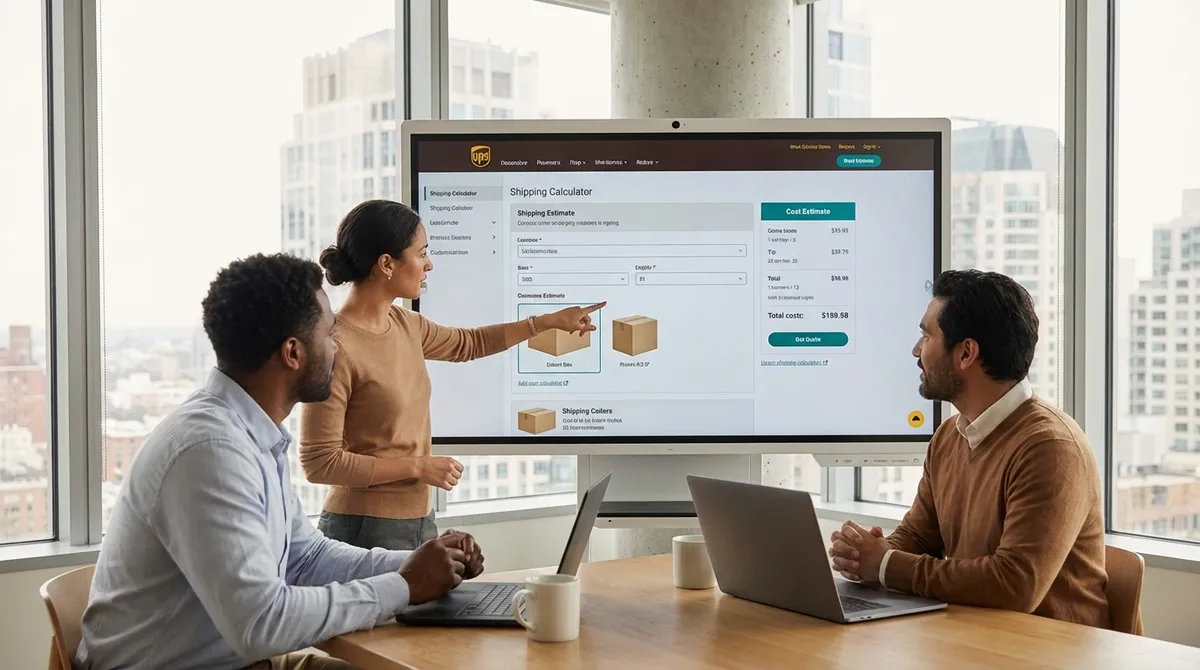
How to Use This UPS Billable Weight Calculator
Our calculator is designed to replicate the official UPS pricing logic for weight and dimensions. Follow these steps to get an accurate assessment of your package's billable weight:
- Measure Dimensions: Measure the length, width, and height of your package in inches. UPS requires you to round each measurement up to the nearest whole inch. For example, 12.2 inches becomes 13 inches.
- Weigh Your Package: Place your fully packed box on a scale to get the actual weight in pounds.
- Select Rate Type: Choose between "Retail Rates" (if you ship occasionally from a UPS Store) or "Daily Rates" (if you have a scheduled pickup account). This determines the divisor used in the calculation (166 vs. 139).
- Calculate: Click the button to see the "Billable Weight." This is the weight UPS will use to calculate your shipping cost.
The Secret to UPS Pricing: Billable Weight
Many shippers are shocked when their shipping bill is higher than expected. The culprit is almost always Billable Weight. UPS does not simply charge based on how heavy a package is; they also charge based on how much space it takes up in their trucks and planes.
UPS compares two weights and charges for the greater of the two:
- Actual Weight: The physical weight of the package as measured on a scale.
- Dimensional Weight (Dim Weight): A calculated weight based on the package's volume.
How Dimensional Weight is Calculated in 2025
The formula for dimensional weight depends on your customer type. Misunderstanding this is the #1 reason for "Shipping Charge Corrections."
(Length × Width × Height) ÷ Divisor = Dim Weight
Used for occasional shippers, UPS Store drop-offs, and standard accounts. This is the "standard" divisor for most small businesses.
Used for high-volume shippers with scheduled daily pickups and negotiated contracts. Although 139 results in a higher billable weight, the base rates for these contracts are usually much lower.
Note: The result is always rounded up to the next whole pound. A calculation of 10.1 lbs becomes 11 lbs.
Real-World Example
Dimensions: 20" x 20" x 20"
Actual Weight: 5 lbs
Calculation (Retail Rate 166):
(20 x 20 x 20) ÷ 166 = 8,000 ÷ 166 = 48.19 lbs.
UPS rounds this up to 49 lbs.
The Verdict: Even though your package only weighs 5 lbs, UPS will charge you as if it weighs 49 lbs. This is why optimizing your packaging is the #1 way to reduce shipping costs.
Hidden Fees: Large Package & Handling Surcharges
Beyond dimensional weight, UPS applies heavy surcharges for packages that exceed certain size limits. Our calculator checks for these automatically, but understanding them is key to prevention.
1. Additional Handling Surcharge (AHS)
This applies if any of the following are true:
- Weight: Actual weight > 50 lbs.
- Length: Longest side > 48 inches.
- Width: Second longest side > 30 inches.
- Packaging: Item is not fully encased in cardboard (e.g., a tire, a bucket, a wooden crate).
Cost impact: varies by zone and type, but typically adds $16 - $35 per package.
2. Large Package Surcharge (LPS)
A package is considered a "Large Package" if its length plus girth `[(2 x width) + (2 x height)]` exceeds 130 inches.
- Consequence: A substantial surcharge is added (often $135 - $165+).
- Minimum Billable Weight: Large Packages are subject to a minimum billable weight of 90 lbs, even if they are lighter.
3. Over Maximum Limits
UPS has hard limits. Packages exceeding these are unauthorized and may be returned or subject to an Over Maximum Limits fee (often exceeding $1,150!).
- Max Weight: 150 lbs.
- Max Length: 108 inches.
- Max Size: 165 inches in length plus girth.
Additional UPS Fees You Need to Know
Billable weight is just the start. UPS adds "Accessorial Charges" that can increase your total shipping cost by 30% or more.
1. Fuel Surcharge (Index-Based)
Unlike the base rate, the fuel surcharge fluctuates weekly based on the national average price of diesel and jet fuel. It applies to the total base rate and most surcharges. In 2024-2025, this can range from 12% to over 18% for Air services.
2. Residential Surcharge
Delivering to a home is more expensive than delivering to a loading dock. UPS charges an extra ~$5.85 (Domestic Ground) for residential deliveries. This is why many businesses prefer "UPS SurePost" (final delivery by USPS) to avoid this fee.
3. Delivery Area Surcharge (DAS)
If you are shipping to a zip code that is considered rural or remote (even if it's just a suburb), UPS adds a DAS fee ranging from $3.95 to over $5.70. For "Extended" areas (very remote), the fee is even higher.
4. Peak Season Surcharges
From October to January (the "Peak Season"), UPS implements "Demand Surcharges." If you are a high-volume shipper sending large packages or requiring additional handling, expect to pay temporary per-package fees to cover the holiday rush capacity.
5. Saturday Delivery
While USPS delivers on Saturdays for free, UPS Ground considers Saturday a premium service in many areas. Adding a "Sat Delivery" option can cost an extra $16 per package unless you are in eligible defined metropolitan areas where it is standard.
How to Measure Irregular Packages
Not all packages are perfect rectangular boxes. If you are shipping a tube, a cylinder, or an irregularly shaped item, you must measure it as if it were enclosed in the smallest possible rectangular box.
- Length: Measure the longest point of the package.
- Width: Measure the widest point perpendicular to the length.
- Height: Measure the highest point perpendicular to the length and width.
Crucial Tip: Always measure to the extreme points, including bulges or irregularities. If your package is soft (like a poly bag), measure it when it is lying flat but fully expanded. UPS scanners use lasers to measure the outermost dimensions, so if a bag bulges in the middle, that bulge determines the dimension.
Audit Fees and Correction Charges
One of the most frustrating experiences for shippers is receiving an invoice that is higher than the quote. This happens when UPS "audits" your package and finds a discrepancy.
UPS facilities are equipped with high-speed automated scanners that measure and weigh packages as they move along the conveyor belt. If the scanner detects that your package is larger or heavier than what you declared:
- Shipping Charge Correction: UPS will automatically update the weight and dimensions to the correct values and charge you the difference in shipping cost.
- Audit Fee: In addition to the shipping difference, you may be charged a "Shipping Charge Correction Audit Fee" (approx $1.00 per package or more depending on contract).
To avoid these fees, always round up your measurements to the next whole inch (e.g., 10.1" = 11") and your weight to the next whole pound. It is better to slightly over-declare and pay a few cents more upfront than to under-declare and face penalties later.
Pro Tips for Reducing UPS Shipping Costs
Shipping can be a major expense, but there are strategies to keep costs down. Here are some actionable tips to optimize your shipping spend:
Right-Size Your Box
Never use a box that is significantly larger than your item. If you are shipping a small item in a large box filled with packing peanuts, you are paying to ship air. Cut down boxes to fit the item snugly.
Know Your Divisor
If you ship frequently, negotiate with UPS to get a better dimensional weight divisor. Moving from a 139 divisor to a 166 divisor can save you 15-20% on shipping costs for lightweight, bulky items.
Avoid Surcharges
Always measure your packages before shipping. If a package is 131 inches in length plus girth, try to find a way to reduce it by just 1 inch to avoid the Large Package Surcharge.
Compare Carriers
For lightweight packages (under 2 lbs), USPS is often cheaper because they do not apply dimensional weight to packages under 1 cubic foot.