Mastering Sales Tax: A Comprehensive Guide for Shoppers and Business Owners
Sales tax is one of the most ubiquitous forms of taxation in the United States, yet it remains one of the most confusing. Unlike many other countries that have a uniform Value Added Tax (VAT), the U.S. relies on a fragmented system of state and local taxes. A single transaction can effectively be taxed four or five times by different overlapping jurisdictions: the state, the county, the city, and special districts for things like transit or schools.
For a consumer, this calculator serves as a crucial budgeting tool. Knowing the "sticker price" is rarely enough; you need to know the "out-the-door" price. For business owners, accurate calculation is not just a convenience—it's a legal requirement with severe penalties for non-compliance. This guide breaks down the mechanics of sales tax, how to calculate it forward and backward, and the complex rules that govern what is and isn't taxable.
The Anatomy of a Sales Tax Rate
When you see a sales tax rate of 8.25%, it is rarely a single tax. it is usually a "combined rate" made up of several layers. Understanding these layers helps explain why the rate changes when you cross the street into a different township.
- State Rate: This is the base rate set by the state legislature. For example, Texas has a base rate of 6.25%. A few states, like Delaware, Montana, Oregon, New Hampshire, and Alaska (nominally), have 0% state sales tax.
- County Rate: Counties often add their own percentage on top of the state rate to fund county services, courts, and jails.
- City/Municipal Rate: Cities add another layer to fund police, fire departments, and local infrastructure.
- Special District Taxes: These are the most variable. A district might be created to fund a specific stadium, a regional transit authority (like BART in the Bay Area or MARTA in Atlanta), or a hospital system. These districts often have irregular boundaries that don't match city lines.
How to Perform the Calculations
Whether you are adding tax to a price or trying to back it out, the math is straightforward once you have the rate.
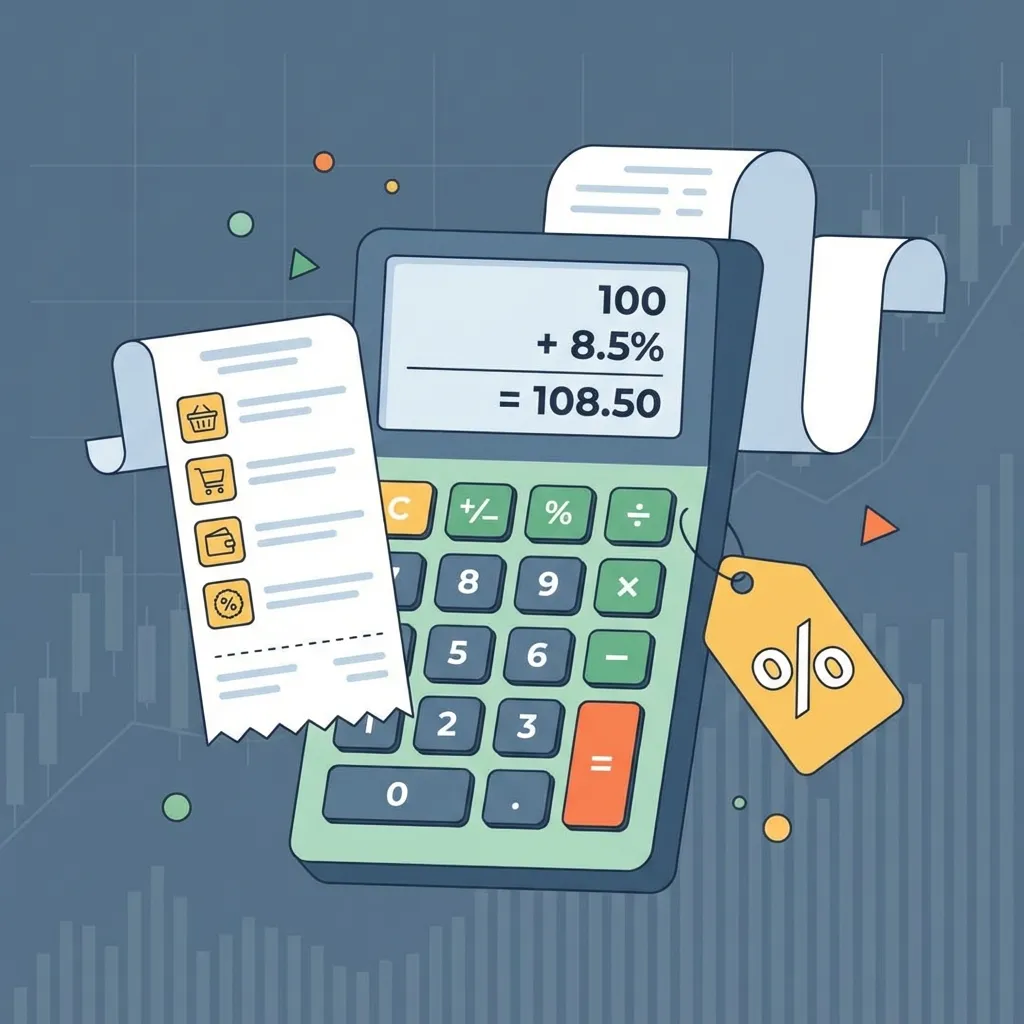
Adding Sales Tax (Net to Gross)
This is the standard calculation at the register.
Example: You are buying a television for $500 in a jurisdiction with a 9.5% tax rate.
- Convert 9.5% to decimal: 0.095
- Add 1 to the decimal: 1.095
- Multiply: $500 × 1.095 = $547.50
Reversing Sales Tax (Gross to Net)
This is useful for businesses who want to sell an item for a flat $20 bill. You need to calculate what the pre-tax price must be so that the total equals exactly $20.
Example: You want a T-shirt to cost exactly $20.00 including 8% tax.
- Convert 8% to decimal: 0.08
- Add 1: 1.08
- Divide: $20.00 / 1.08 = $18.5185...
- Round to nearest cent: $18.52
So you would list the price as $18.52. The tax would be $1.48, totaling $20.00.
For Sellers: Origin-Based vs. Destination-Based Rules
If you run a business, knowing which tax rate to charge is critical. This depends on whether your state uses **Source-Based (Origin)** or **Destination-Based** sourcing rules.
- Origin-Based States: The tax rate is determined by the seller's location. If your warehouse is in Austin, TX, you charge the Austin rate (8.25%) on all shipments within Texas, regardless of whether the customer lives in Houston or a rural county with a lower rate. Examples include Texas, Pennsylvania, Ohio, and Arizona.
- Destination-Based States: The tax rate is determined by the buyer's location. If you are in New York City but ship to a customer in Buffalo, you must charge the sales tax rate applicable to Buffalo. This is more complex for sellers as they must track thousands of tax jurisdictions. Most states (about 40 of them) use destination-based sourcing for interstate sales.
The Revolution of "Economic Nexus"
For decades, businesses only had to collect sales tax in states where they had a physical presence (a store, an office, employees, or inventory). This was known as "physical nexus."
This changed forever with the 2018 Supreme Court ruling in South Dakota v. Wayfair, Inc. The court ruled that states can require out-of-state sellers to collect sales tax if they meet a certain level of economic activity in the state, known as Economic Nexus.
Typically, economic nexus is triggered if you:
- Have more than $100,000 in sales into the state annually.
- Process more than 200 separate transactions into the state annually.
This means a small seller in Maine might have to register and collect taxes in California if they sell enough products there.
What is Taxable? (Taxability Rules)
Not everything is taxed. State legislatures carve out exemptions for political, economic, or social reasons.
- Groceries: Most states exempt "unprepared food" (groceries) to avoid taxing survival necessities. However, prepared food (restaurants, hot deli items) is almost always taxed. Some states, like Idaho, tax groceries but offer a tax credit to offset it.
- Prescription Drugs & Medical Devices: Almost universally exempt.
- Clothing: This is highly variable. Pennsylvania, New Jersey, Minnesota, and Vermont generally exempt clothing. Massachusetts exempts clothing items under $175. NYC acts similarly with items under $110. Most other states tax clothing fully.
- Digital Goods: Software, ebooks, and streaming services are a gray area. Some states tax them as "tangible personal property," while others do not.
- Services: Historically, services (haircuts, consulting, repair) were not taxed. However, as the economy shifts from goods to services, more states are expanding their tax base to include services like landscaping, gym memberships, and SaaS (Software as a Service).
What is Use Tax?
Use Tax is the "mirror image" of sales tax. It is designed to protect local businesses.
Scenario: You live in a state with 6% sales tax. You drive across the border to a state with 0% tax to buy a $2,000 appliance. You saved $120. However, legally, when you bring that appliance back home to use it, you owe your state that $120 as "Use Tax."
While rarely enforced against individuals for small purchases, state auditors aggressively pursue businesses for unpaid Use Tax on office furniture, computers, and equipment purchased from out-of-state vendors who didn't charge tax. Note that sales tax is separate from revenue-based business taxes — if you operate in Ohio, Texas, Washington, Nevada, or Oregon, estimate those with our gross receipts tax calculator.
Frequently Asked Questions (FAQ)
1. Is shipping and handling taxable?
It depends on the state. Approximately half of the states consider shipping part of the selling price and therefore taxable. The other half consider shipping a separate service that is exempt—provided it is listed as a separate line item on the invoice. If you bundle the price ("Free Shipping"), the whole amount is taxable.
2. What are Sales Tax Holidays?
Many states hold annual "Sales Tax Holidays," usually just before another school year starts in August. During this weekend, specific items like school supplies, computers (under a price cap), and clothing are temporarily exempt from sales tax. It is a popular time for large purchases.
3. Do I have to pay sales tax on used items?
Generally, yes. If you buy a used item from a business (like a used car dealer or a consignment shop), sales tax applies. However, "casual sales" between individuals (like a garage sale or a CraigsList meetup) are often exempt in many states, though regulations vary. Vehicles are the big exception; you almost always pay tax when registering a vehicle, even if bought from a private party.
4. Can I deduct sales tax on my federal return?
Yes, thanks to the Tax Cuts and Jobs Act (TCJA). When you file Schedule A (Itemized Deductions), you can choose to deduct either your state and local income taxes OR your state and local sales taxes, but not both.
This deduction is capped at $10,000 per year (the SALT cap). The sales tax deduction is primarily used by residents of states with no income tax (Washington, Texas, Florida, Nevada, etc.), as it is their only way to get a federal deduction for state taxes paid. You can either track all your receipts for the year or use the IRS optional sales tax tables based on your income.
5. How do I verify a tax rate?
Never rely on a zip code alone. Zip codes are for mail delivery, not taxation, and often cross city and county lines. The only accuracy way to determine a rate is by geocoding the specific street address. State DOR websites often provide tools for this verification.
Use this calculator as a quick reference tool, but for complex business compliance, always consult with a Certified Public Accountant (CPA) or sales tax compliance professional.