A business tax return calculator helps you estimate whether your company will owe additional tax or receive a refund when you file. If you earned $250,000 in revenue, spent $80,000 on expenses, and made $20,000 in estimated quarterly payments, you might assume things roughly balance out — but the reality depends on your entity type, filing status, deductions, and credits. Most small business owners discover a gap of $2,000 to $15,000 between what they paid and what they actually owe, and that gap can swing either direction.
This calculator computes your total federal and state tax liability for sole proprietorships (Schedule C), S corporations (Form 1120S), and C corporations (Form 1120), then compares it against your estimated payments and withholding to show your refund or balance due. The article below walks through the math, shows worked examples, and explains how to avoid underpayment penalties that cost business owners an average of $500 to $1,200 per year.
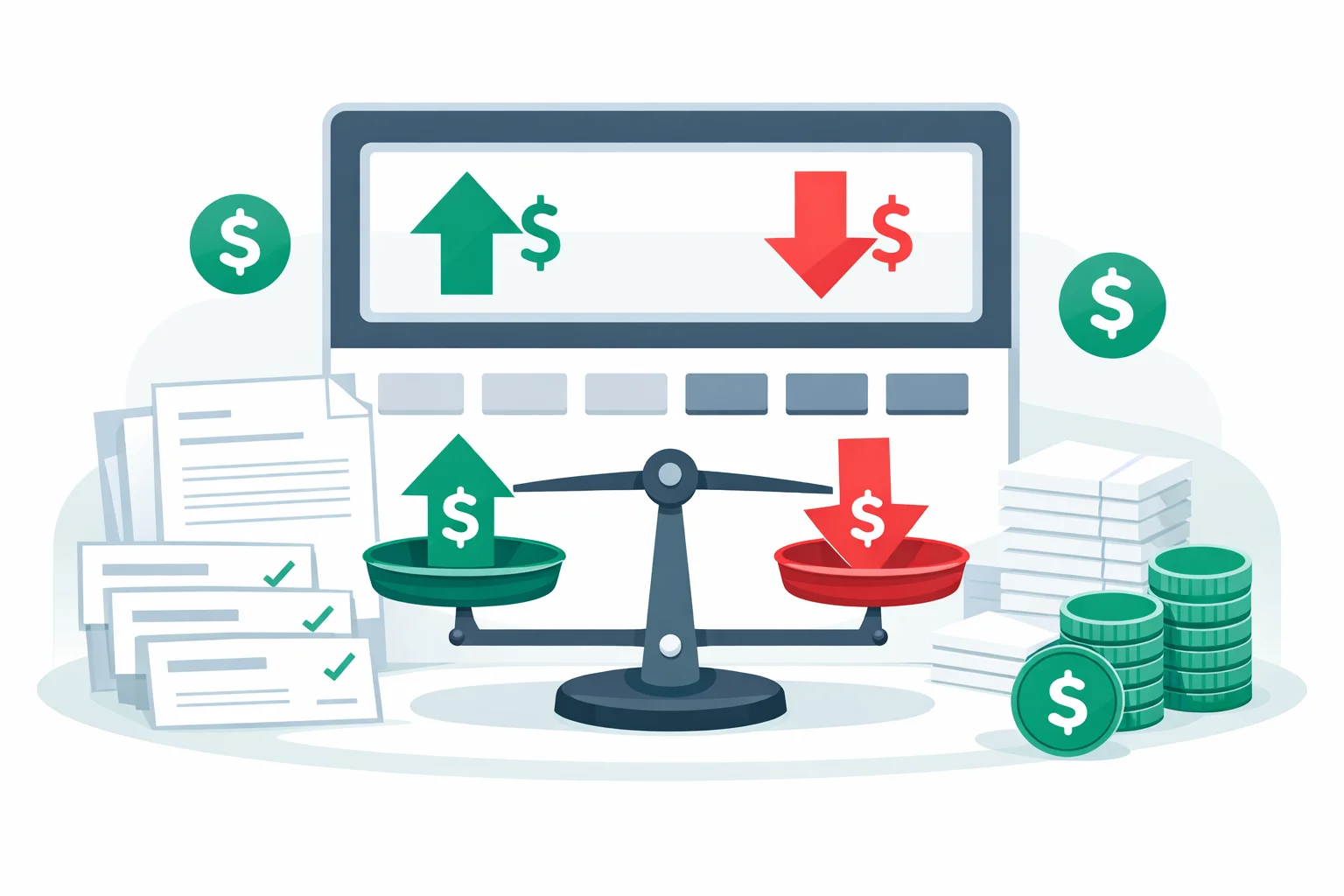
How the Business Tax Return Calculator Works
The core formula behind every business tax return is straightforward: subtract what you've already paid from what you actually owe. If the number is positive, you get a refund. If it's negative, you owe the IRS. Here's the step-by-step calculation the tool performs for each entity type.
Step 1: Calculate Net Business Profit
Start with gross revenue and subtract all deductible business expenses — cost of goods sold, rent, payroll, insurance, depreciation, office supplies, and professional services. For example, $250,000 revenue minus $80,000 in expenses gives you $170,000 net profit. This is your starting point regardless of entity type.
Step 2: Determine Tax Liability by Entity Type
Your entity structure dramatically changes how much you owe. A sole proprietor earning $170,000 pays self-employment tax on 92.35% of that profit (roughly $24,000 in SE tax alone), plus federal income tax. An S Corp owner paying themselves a $70,000 salary cuts that payroll tax bill to around $10,700 — saving over $13,000. A C Corp pays a flat 21% corporate rate ($35,700), but the owner faces double taxation if they take dividends.
Step 3: Compare Liability Against Payments
The calculator totals your four quarterly estimated payments (Forms 1040-ES or 1120-W) plus any W-2 withholding, then subtracts your total tax liability. If you paid $20,000 in estimated taxes but owe $42,000, you have a $22,000 balance due. If you paid $50,000 but only owe $42,000, you're getting an $8,000 refund.
Key Factors That Affect Your Tax Return Outcome
Five variables have the biggest impact on whether you end up with a refund or a balance due. Understanding each one helps you plan estimated payments more accurately throughout the year.
- Entity type— A sole proprietor on $150,000 net income pays roughly $21,200 in SE tax. The same income through an S Corp with a $65,000 salary drops payroll taxes to about $9,900, a difference of $11,300 per year.
- Estimated payment accuracy— Underpaying by even 10% triggers an IRS penalty. On a $40,000 liability, paying only $16,000 in estimated taxes (instead of $36,000+) could cost you $1,600–$1,900 in penalties at the current 8% annual rate.
- QBI deduction (Section 199A)— Pass-through entities can deduct up to 20% of qualified business income. On $170,000 profit, that's a $34,000 deduction that saves $7,500–$12,500 in federal tax depending on your bracket.
- Tax credits— The R&D credit alone can offset $5,000–$250,000+ in tax liability. Energy credits, the Work Opportunity Tax Credit, and employer-provided childcare credits directly reduce your balance due dollar-for-dollar.
- State tax rate— Moving from California (13.3% top rate) to Texas (0%) on $170,000 income saves roughly $22,600 in state taxes annually. Even a 2% rate difference on that income equals $3,400.
Worked Example: Sole Proprietor Filing Single
Let's walk through a complete calculation for a freelance consultant earning $200,000 with $40,000 in business expenses and no other income. This example uses 2025 tax constants.
| Line Item | Amount |
|---|---|
| Gross Revenue | $200,000 |
| Business Expenses | −$40,000 |
| Net Profit (Schedule C) | $160,000 |
| SE Tax Base (92.35%) | $147,760 |
| Social Security (12.4% up to $176,100) | $18,322 |
| Medicare (2.9%) | $4,285 |
| Total SE Tax | $22,607 |
| Half SE Tax Deduction | −$11,304 |
| QBI Deduction (20%) | −$32,000 |
| Standard Deduction (Single) | −$15,750 |
| Taxable Income | $100,946 |
| Federal Income Tax | $17,021 |
| State Tax (5%) | $8,000 |
| Total Tax Liability | $47,628 |
| Estimated Payments Made (4 × $10,000) | −$40,000 |
| Amount Due at Filing | $7,628 |
This freelancer owes $7,628 at tax time despite making $40,000 in estimated payments. To avoid underpayment penalties next year, they should increase each quarterly payment to approximately $11,907 ($47,628 ÷ 4). Alternatively, they could meet the safe harbor by paying 100% of the prior year's tax liability spread across four equal installments.
Tax Return Outcomes by Entity Type
The same $160,000 net profit produces dramatically different tax bills depending on how your business is structured. Here's a side-by-side comparison using the same assumptions: single filer, 5% state rate, no other income, $40,000 in estimated payments.
| Tax Component | Sole Prop | S Corp ($65K salary) | C Corp |
|---|---|---|---|
| SE / Payroll Tax | $22,607 | $9,945 | $0 |
| Federal Income Tax | $17,021 | $18,762 | $0* |
| Corporate Tax (21%) | $0 | $0 | $33,600 |
| State Tax (5%) | $8,000 | $7,335 | $8,000 |
| Total Tax | $47,628 | $36,042 | $41,600 |
| After $40K Payments | Owe $7,628 | Refund $3,958 | Owe $1,600 |
*C Corp personal income tax is $0 in this example because we assume no salary or dividends for simplicity. In practice, C Corp owners would also pay personal income tax on their salary and dividend income. The S Corp structure produces the best outcome here — $11,586 less in total tax than the sole proprietorship, primarily from the $12,662 reduction in payroll taxes. Use our S Corp tax calculator for a detailed comparison with salary optimization.
Common Mistakes That Increase Your Tax Bill
Business owners routinely leave money on the table or trigger unnecessary penalties. These four mistakes are the most expensive ones we see, and all of them are avoidable with proper planning.
- Skipping quarterly payments entirely— The IRS charges an underpayment penalty when you owe more than $1,000 at filing and haven't paid at least 90% of your current-year liability (or 100% of last year's). On a $45,000 liability with zero estimated payments, the penalty runs $3,600 at the current 8% rate. That's money you'll never get back.
- Not claiming the QBI deduction— About 30% of eligible sole proprietors and S Corp owners miss the Section 199A deduction according to IRS data. On $150,000 in qualified business income, that's a $30,000 deduction worth $6,600–$11,100 in tax savings.
- Using last year's income to set this year's payments— If your business grew 40% but your estimated payments stayed flat, you'll face a large balance due plus penalties. Recalculate estimated payments each quarter using year-to-date actuals, not last year's numbers. Our estimated tax calculator helps you set the right quarterly amount.
- Filing as the wrong entity type— A sole proprietor earning $120,000+ who hasn't evaluated the S Corp election is potentially overpaying by $5,000–$15,000 annually in self-employment tax. The corporate tax calculator shows the entity-by-entity comparison.
How to Avoid Underpayment Penalties
The IRS safe harbor rules give you two paths to avoid Form 2210 penalties. Meeting either one means zero penalty, even if you end up owing at filing time.
- 90% current-year rule— Pay at least 90% of your current year's tax liability through estimated payments and withholding. If you owe $50,000, pay at least $45,000 across the four quarters.
- 100/110% prior-year rule— Pay 100% of your prior year's tax liability (110% if your AGI exceeds $150,000). This is the safer option when your income fluctuates. If you paid $38,000 last year and your AGI was over $150,000, pay $41,800 this year ($38,000 × 110%).
In practice, most accountants recommend the prior-year safe harbor for business owners with variable income. It's predictable — you know exactly what to pay each quarter before the year starts. Track your payments using our business tax calculator to compare entity-level tax burdens and plan ahead. You can also review your IRS tax liability for a personal-focused estimate.
Practical Tips for Tax Season
These specific actions reduce your tax bill or protect you from surprises at filing time. Each one is backed by a concrete dollar impact.
- Max out retirement contributions before December 31— A SEP-IRA allows up to 25% of net self-employment income (max $70,000 for 2025). Contributing $40,000 to a SEP on $160,000 income saves $8,800–$14,800 in federal tax depending on your bracket.
- Accelerate deductions in high-income years— Prepay January rent in December, stock up on supplies, or purchase equipment eligible for Section 179 expensing (up to $1,220,000 for 2025). A $30,000 equipment purchase saves $6,600–$11,100 in the year of purchase.
- Review your W-4 if you have a side job— Business owners with W-2 income from a spouse or part-time job can increase withholding to cover estimated tax obligations. This avoids quarterly payment paperwork and spreads the burden evenly. Use our W-4 calculator to find the right withholding amount.
- File on time, even if you can't pay— The late-filing penalty is 5% per month (up to 25%). The late-payment penalty is only 0.5% per month. Filing on time and requesting a payment plan saves you 90% of the penalty cost. Request an extension by April 15 if you need more time to prepare your return.
For more on payroll tax obligations and employer costs, check our payroll tax calculator or the business loan calculatorif you're considering financing a tax payment.
The IRS provides the official estimated tax worksheet in Form 1040-ES instructions. For C corporations, use Form 1120-W to compute required installments.