A C corp tax calculator helps you estimate the total tax cost of earning and distributing profits through a C corporation — including both the 21% corporate-level tax and the second layer of tax when dividends reach your personal return. If your C corp earns $250,000 in taxable income, the corporation pays $52,500 in federal tax. Distribute the remaining $197,500 as qualified dividends, and you owe another $29,625 at the 15% rate — bringing your combined tax bill to $82,125 and your effective rate to 32.9%. That's the double taxation problem in one sentence.
This article breaks down the exact math behind C corp taxation, walks through worked examples at multiple income levels, compares retained earnings vs. distribution strategies, and shows you when the flat 21% rate actually works in your favor. We'll also cover the Net Investment Income Tax, state-level corporate taxes, and the accumulated earnings tax trap that catches C corp owners who try to defer dividends indefinitely.
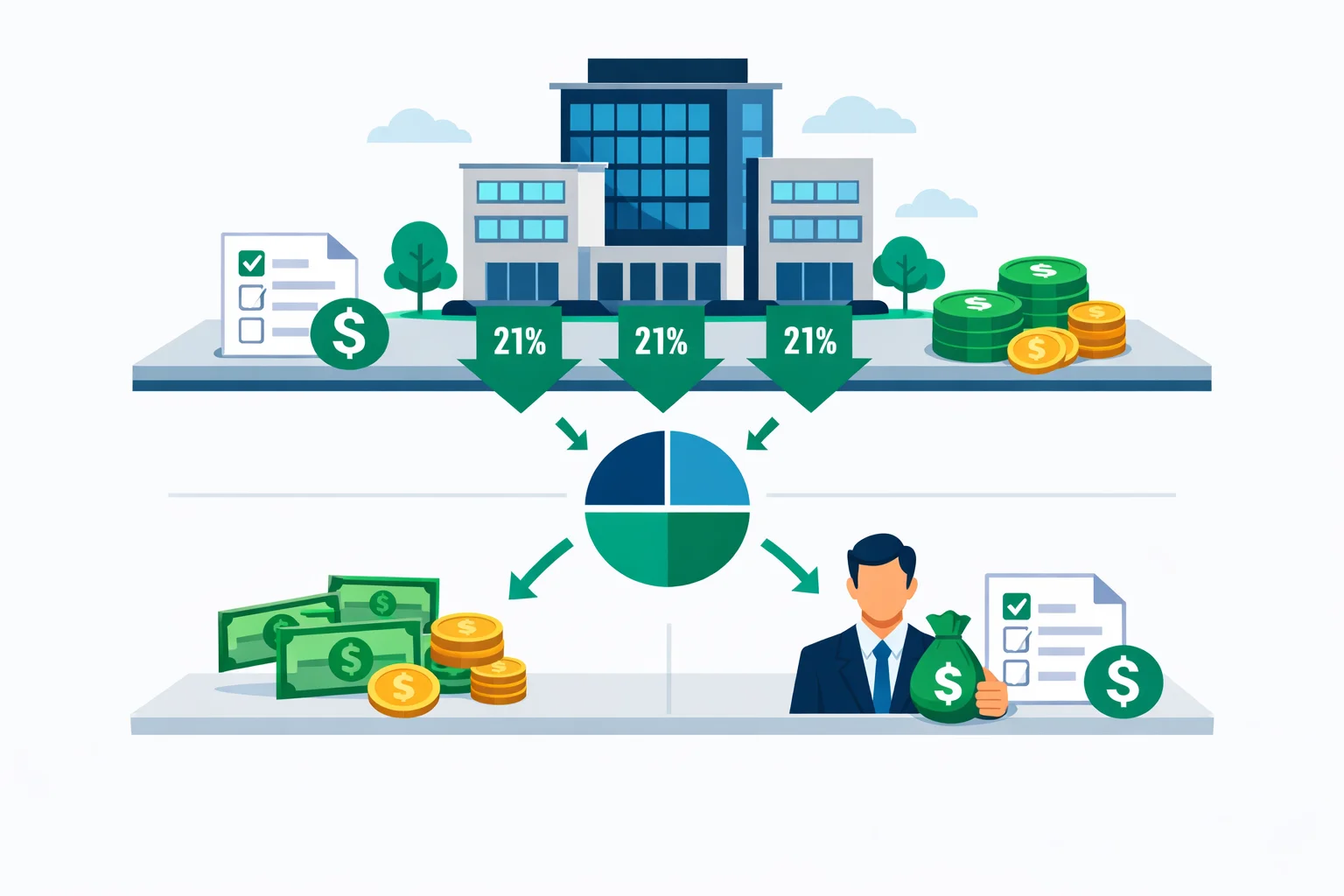
How C Corp Double Taxation Works
A C corporation is the only business entity type that pays federal income tax at the entity level. Every other structure — S corps, LLCs, partnerships, sole proprietorships — passes income through to the owner's personal return and is taxed once. The C corp pays tax twice because the corporation and its shareholders are treated as separate taxpayers.
The two layers work like this:
- Layer 1 — Corporate tax: The corporation pays a flat 21% federal income tax on taxable income (revenue minus deductions). Most states add 2-12% on top. This tax is paid regardless of whether profits are distributed or retained.
- Layer 2 — Shareholder dividend tax: When the corporation distributes after-tax profits as dividends, shareholders pay qualified dividend tax at 0%, 15%, or 20% depending on their total taxable income. High earners also owe the 3.8% Net Investment Income Tax (NIIT).
The combined effect means every dollar of C corp profit can lose 39.8% or more to federal taxes alone before it reaches the owner's bank account. Compare that to a pass-through entity like an S corporation, where the same profit is taxed once at the owner's individual rate (typically 22-37%).
Worked Example: $250,000 Corporate Income
Let's walk through the full calculation for a single-filer C corp owner with $250,000 in corporate taxable income, a 5% state corporate tax rate, no other personal income, and full dividend distribution.
Layer 1: Corporate Tax
Federal corporate tax: $250,000 × 21% = $52,500. State corporate tax: $250,000 × 5% = $12,500. Total corporate tax: $65,000. After-tax corporate income: $250,000 − $65,000 = $185,000. This $185,000 is now available for distribution or retention.
Layer 2: Shareholder Dividend Tax
The full $185,000 is distributed as qualified dividends. At $185,000 total income (single filer), the qualified dividend rate is 15%. Dividend tax: $185,000 × 15% = $27,750. No NIIT applies here because total income is below the $200,000 threshold. Net to shareholder: $185,000 − $27,750 = $157,250.
Combined Result
Total tax paid: $65,000 (corporate) + $27,750 (dividend) = $92,750. Effective combined rate: $92,750 ÷ $250,000 = 37.1%. The shareholder keeps $157,250 out of $250,000 in corporate earnings. At higher income levels where the 20% dividend rate and 3.8% NIIT apply, the combined rate climbs to 44.8% or more.
C Corp Tax Rates by Income Level
The corporate rate is flat at 21%, but the dividend tax layer varies by income. Here's how the combined effective rate changes at different income levels, assuming a 5% state corporate tax rate, single filing status, and 100% dividend distribution.
| Corporate Income | Corporate Tax (26%) | After-Tax Dividends | Dividend Tax Rate | Dividend Tax | Combined Rate |
|---|---|---|---|---|---|
| $50,000 | $13,000 | $37,000 | 0% | $0 | 26.0% |
| $100,000 | $26,000 | $74,000 | 15% | $11,100 | 37.1% |
| $250,000 | $65,000 | $185,000 | 15% | $27,750 | 37.1% |
| $500,000 | $130,000 | $370,000 | 15% | $55,500 | 37.1% |
| $1,000,000 | $260,000 | $740,000 | 20% + NIIT | $176,120 | 43.6% |
The 0% dividend rate applies when the shareholder's total income stays below $48,475 (single) or $96,950 (married filing jointly) for 2025. Above $533,400 (single) or $600,050 (married), the 20% rate kicks in, plus the 3.8% NIIT above $200,000/$250,000. Use our tax bracket calculator to check where your personal income falls.
Key Factors That Affect Your C Corp Tax Burden
Five variables determine whether the C corp structure costs you more or less than a pass-through entity. Each one shifts the math significantly.
- Distribution timing.Unlike pass-through entities where you owe tax on income regardless of distributions, the C corp's second tax layer only triggers when dividends are actually paid. Retaining $100,000 defers $15,000-$23,800 in dividend tax until a future year. This is the C corp's biggest advantage for businesses that reinvest heavily.
- State corporate tax rates. States range from 0% (Nevada, Ohio, Texas, Wyoming) to 11.5% (New Jersey). A 10% state rate pushes the corporate layer alone to 31%, making the combined double-tax rate 44%+ before the 20% dividend tier even applies. Check our state tax calculatorfor your state's rate.
- Shareholder's other income. If you have $200,000+ in W-2 income from another job, dividends from your C corp land in the 15-20% bracket immediately, and the 3.8% NIIT adds further cost. A shareholder with zero other income might qualify for the 0% qualified dividend rate on the first $48,475 of dividends.
- Salary vs. dividends.C corp owners who work in the business can pay themselves a salary, which is deductible to the corporation. A $100,000 salary on $250,000 profit reduces the corporate taxable income to $150,000 — saving $21,000 in corporate tax — though the salary is subject to payroll taxes. Use our corporate tax calculator to compare salary and distribution splits.
- Qualified vs. ordinary dividends.Only qualified dividends get the preferential 0/15/20% rates. To qualify, the shareholder must hold the stock for at least 61 days during the 121-day period around the ex-dividend date. Ordinary dividends are taxed at the shareholder's marginal income tax rate (up to 37%), which can push the combined rate above 50%.
Retained Earnings vs. Distribution: A Decision Framework
The decision to distribute or retain C corp profits has major tax consequences. Here's a framework based on the math.
| Scenario | Best Strategy | Why |
|---|---|---|
| Business needs capital for growth | Retain earnings | Defer dividend tax; reinvest at 21% cost instead of 37%+ |
| Owner needs cash, low other income | Distribute (may get 0% rate) | Dividends below $48K/$97K threshold are tax-free at shareholder level |
| Retained earnings exceed $250,000 | Distribute or document purpose | IRS accumulated earnings tax (20%) applies to excess without business justification |
| Planning to sell the company | Retain and sell stock | Built-up earnings sell as capital gains; avoids dividend tax entirely |
| Owner in the 20% + NIIT bracket | Minimize distributions | 23.8% dividend rate makes the combined rate 44.8%; retention defers this cost |
The accumulated earnings tax is a common trap. The IRS allows C corps to retain up to $250,000 ($150,000 for personal service corporations) without question. Beyond that, the corporation must demonstrate a reasonable business need for the retained funds — equipment purchases, expansion plans, debt repayment, or working capital reserves. Without documentation, the IRS can impose a 20% penalty tax on the excess retained earnings, effectively forcing distribution.
Common Mistakes That Cost C Corp Owners Money
We've found that C corp owners make these four costly errors more than any others, and each one has a specific dollar consequence.
- Ignoring the salary deduction. Owner-employees who take all compensation as dividends miss the corporate deduction. A $100,000 salary is fully deductible, saving the corporation $21,000 in federal tax. Yes, you owe payroll taxes on the salary (~$15,300 on $100K), but the net savings from the corporate deduction plus avoiding the dividend tax layer is often $3,000-$8,000 per year. Our payroll tax calculator shows the exact payroll cost.
- Distributing when in the 20% + NIIT bracket.A shareholder earning $600,000+ in total income pays 23.8% on qualified dividends. On $200,000 in distributions, that's $47,600 in dividend tax. If the business can justify retention, deferring those distributions saves $47,600 this year.
- Failing to meet the qualified dividend holding period.If shares aren't held for 61+ days, dividends are taxed as ordinary income — at rates up to 37% instead of 20%. On $150,000 in dividends, the difference between 15% ($22,500) and 37% ($55,500) is $33,000 in additional tax.
- Not tracking basis for distributions.Distributions that exceed the shareholder's stock basis are taxed as capital gains, not dividends. Without careful basis tracking (contributions, earnings, prior distributions), you may accidentally trigger higher capital gains tax or even double-count income. Keep meticulous records of every capital contribution and distribution.
Practical Tips for Minimizing C Corp Double Taxation
While double taxation is unavoidable with a C corp, there are legitimate strategies to reduce its impact. Each one has specific dollar savings at common income levels.
- Maximize deductible compensation.Salary, bonuses, and benefits (health insurance, retirement contributions, education assistance) are all deductible to the corporation. A $70,000 salary plus $20,000 in benefits removes $90,000 from the corporate tax base, saving $18,900 in federal corporate tax. The IRS allows C corp-paid health insurance premiums as a business deduction with no income limit — unlike S corps, where it's added to the owner's W-2.
- Time distributions to low-income years. If you plan to take a sabbatical, retire, or have a year with lower other income, distribute accumulated earnings during that year. Dropping from the 20% to the 15% dividend bracket on $200,000 in dividends saves $10,000. Dropping to the 0% bracket on $48,000 saves $7,200.
- Consider the Section 1202 exclusion.If your C corp qualifies as a Qualified Small Business Stock (QSBS) issuer and you hold shares for 5+ years, you can exclude up to $10 million (or 10× basis) in capital gains when you sell. This effectively eliminates the second layer of tax on retained earnings for qualifying businesses. See IRS Publication 550 for eligibility rules.
- Use retirement plan contributions.A C corp can sponsor a 401(k) with employer matching up to 25% of compensation. On a $100,000 salary, that's $25,000 in employer contributions that are deductible to the corporation (saving $5,250 in corporate tax) and tax-deferred to the employee. Combined with the $23,500 employee deferral limit for 2025, you can shelter $48,500 from current taxes. Use our investment calculator to project the growth of tax-deferred retirement funds.
C Corp vs. Pass-Through Entities: When Does the C Corp Win?
Despite the double taxation disadvantage, the C corp structure makes financial sense in three specific scenarios.
- High reinvestment businesses.If your company reinvests 80-100% of profits into growth (hiring, R&D, equipment, acquisitions), the 21% flat corporate rate beats the top individual rate of 37%. On $500,000 in profit that's fully retained, you pay $105,000 in corporate tax vs. $185,000 at the 37% individual rate — a $80,000 annual advantage that compounds as the business grows.
- Venture-funded startups. Investors prefer C corps because of the QSBS exclusion (Section 1202), which allows tax-free gains up to $10 million on a future sale. The C corp also has no restrictions on number or type of shareholders, unlike S corps.
- Businesses with significant fringe benefits.C corps can deduct the full cost of employee health insurance, life insurance up to $50,000, and certain education benefits without adding them to the employee's taxable income. For an owner with a family health plan costing $25,000/year, this saves roughly $9,250 in combined taxes (corporate deduction + no income inclusion) compared to an S corp.
For a side-by-side comparison of C corp vs. S corp total tax at your specific income level, try our corporate tax calculator. If you're considering the S corp route, our S corp tax calculator shows the self-employment tax savings in detail. Business owners comparing all entity types should start with the business tax calculator for a broader view.