Understanding the Impact of ETF Expense Ratios and Rebalancing
Investing in Exchange-Traded Funds (ETFs) has become one of the most popular ways to build wealth over the long term. They offer diversification, low costs, and ease of trading. However, two critical factors often go overlooked by even seasoned investors: expense drag and portfolio rebalancing. Our ETF Calculator: Expense Drag, Returns & Rebalancing is designed to shed light on these hidden costs and mechanics, helping you maximize your investment returns. By understanding how small fees compound over time and how rebalancing maintains your risk profile, you can make smarter decisions that could save you thousands of dollars.
Whether you are a passive investor following a "set it and forget it" strategy or an active trader managing a complex portfolio, knowing the true cost of your investments is paramount. This guide will walk you through the mechanics of expense ratios, the "drag" they create on your portfolio's growth, and the mathematical necessity of rebalancing to stay on track with your financial goals.
What is Expense Drag in ETF Investing?
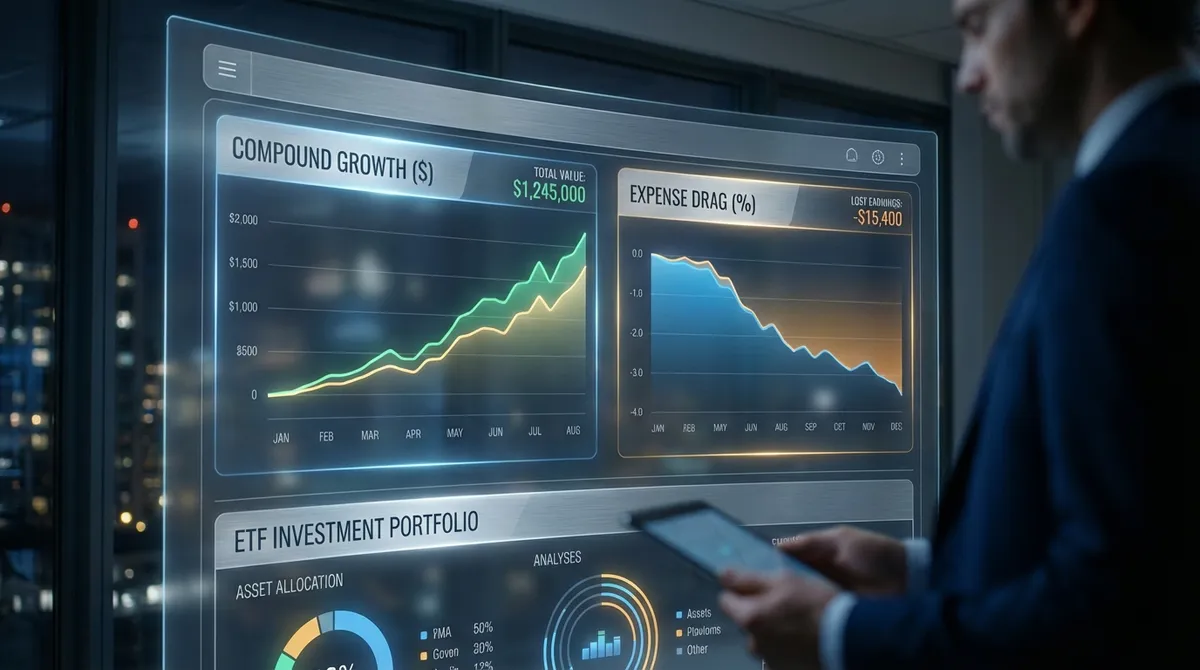
Expense drag refers to the reduction in investment returns caused by the costs associated with managing an investment fund. In the context of ETFs, this is primarily driven by the Expense Ratio. While a 0.50% fee might sound negligible, its impact over 20 or 30 years can be staggering due to the power of lost compounding. It's not just the fee you pay; it's the growth you lose on that money that would have otherwise been invested.
For example, if you invest $10,000 with a 7% annual return and a 0.50% expense ratio, you aren't just losing 0.50% of your balance each year. You are effectively earning a 6.50% return. Over 30 years, that small difference can amount to tens of thousands of dollars in lost wealth. This phenomenon is known as "drag" because it acts as a friction force, slowing down the velocity of your portfolio's growth.
The Components of ETF Costs
When evaluating an ETF, the expense ratio is the most visible cost, but it's not the only one. Understanding the full picture helps you use our calculator more effectively. If you want to isolate just the fee impact, you can also use our dedicated Expense Ratio Calculator.
- Management Fees: The fee paid to the fund manager for selecting assets and managing the portfolio.
- Administrative Costs: Expenses related to record-keeping, legal compliance, and shareholder services.
- Marketing (12b-1) Fees: Fees used to market and distribute the fund, though these are less common in modern low-cost ETFs.
- Trading Costs: While not part of the expense ratio, the bid-ask spread and commissions (if any) also act as a drag on returns.
For a deeper dive into investment costs, Investopedia's guide to expense ratios provides excellent resources on how fees impact your retirement savings.
How to Use This Calculator
Our tool is split into two powerful modules: Growth & Fees and Rebalancing. Here is a step-by-step guide to mastering both features to optimize your portfolio.
Using the Growth & Fees Module
This tab helps you visualize the long-term impact of expense ratios on your potential wealth.
- Initial Investment: Enter the lump sum you are starting with today.
- Monthly Contribution: Input the amount you plan to add to your investment each month. Consistent contributions are key to long-term growth.
- Annual Return (%): Estimate your expected gross annual return. The S&P 500 has historically returned about 10% annually before inflation, but 7-8% is a conservative estimate for diversified portfolios. You can check historical performance with our S&P 500 Calculator.
- Expense Ratio (%): Enter the expense ratio of the ETF you are analyzing. You can find this on the fund provider's website or financial news sites.
- Time Horizon (Years): Specify how long you plan to hold the investment. The longer the horizon, the more significant the expense drag becomes. For general long-term projections, our Investment Growth Calculator is also a great tool.
The calculator will generate a chart comparing your "Gross Value" (if there were zero fees) vs. your "Net Value" (actual projected value). The difference is your total cost, which includes both the fees paid and the lost opportunity cost.
Using the Rebalancing Module
Rebalancing is the process of realigning the weightings of your portfolio of assets. This tab calculates exactly how much of an asset you need to buy or sell to return to your target allocation.
- Total Portfolio Value: Enter the total current value of your entire portfolio (cash + all investments).
- Asset Current Value: Enter the current market value of the specific ETF or asset class you are checking (e.g., your Total Stock Market ETF holding).
- Target Allocation (%): Input the percentage of your portfolio that you want this asset to represent (e.g., 60% for stocks).
The result will tell you the precise dollar amount to Buy or Sell to reach your target. It also shows your current allocation percentage so you can see how far you've drifted.
Why Portfolio Rebalancing is Critical
Rebalancing is often counter-intuitive because it involves selling assets that have performed well (selling high) and buying assets that have underperformed (buying low). However, this discipline is essential for risk management. Without rebalancing, a portfolio designed to be moderate risk (e.g., 60% stocks / 40% bonds) could drift into a high-risk allocation (e.g., 80% stocks / 20% bonds) after a strong bull market, leaving you vulnerable to a market crash.
According to Investopedia, rebalancing helps investors stick to their long-term financial plan regardless of short-term market volatility. It imposes a disciplined framework for taking profits and reinvesting in undervalued assets. To see how reinvesting dividends plays a role, check out our Dividend Reinvestment Calculator.
When Should You Rebalance?
There are two common strategies for timing your rebalancing:
- Time-Based: Rebalancing on a set schedule, such as quarterly, semi-annually, or annually. This is the simplest method to automate.
- Threshold-Based: Rebalancing only when an asset class drifts by a certain percentage from its target (e.g., +/- 5%). This minimizes transaction costs but requires more frequent monitoring.
Pro Tips for Minimizing Costs
While you cannot control the market's return, you can control your costs. Here are actionable tips to reduce expense drag and keep more of your money.
1. Choose Low-Cost Index Funds
Active management often comes with high fees (0.75% to 1.50% or more) and rarely beats the market consistently. Passive index ETFs often have expense ratios as low as 0.03% to 0.10%. Over 30 years, switching from a 0.75% fund to a 0.05% fund can save you hundreds of thousands of dollars on a significant portfolio. You can verify the annualized growth impact with our CAGR Calculator.
2. Watch Out for Trading Commissions
Many brokerages now offer zero-commission trading for ETFs, but some still charge fees, especially for mutual funds or specific transaction types. Ensure your broker is competitive.
3. Consider Tax Efficiency
ETFs are generally more tax-efficient than mutual funds due to their creation/redemption mechanism. However, frequent rebalancing in a taxable account can trigger capital gains taxes. Consider rebalancing by directing new contributions to underweighted assets rather than selling winning assets.
Frequently Asked Questions (FAQ)
Conclusion
Successful investing isn't just about picking the next big winner; it's about controlling what you can control. Fees and asset allocation are two of the most powerful levers in your financial toolkit. By using our ETF Calculator to visualize the long-term impact of expense ratios and to execute precise rebalancing trades, you are taking a professional approach to portfolio management.
Remember, a penny saved in fees is a penny that compounds for your future. Keep your costs low, stay diversified, and rebalance regularly to navigate the markets with confidence. For more tools to help you manage your money, check out our Investing & Markets category.