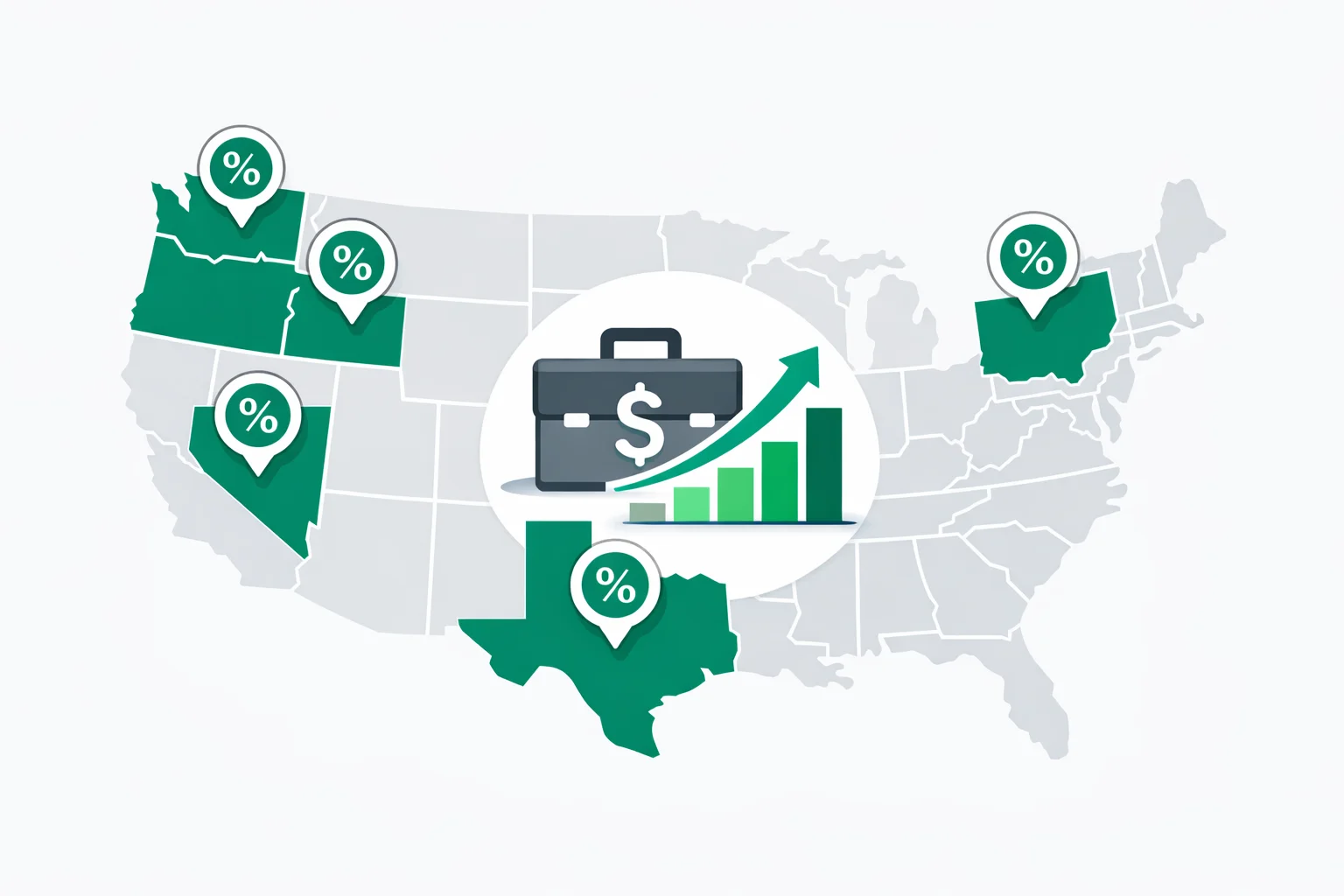
A gross receipts tax calculatortells you what your business owes when a state taxes your total revenue instead of your profit — and the bill can be brutal if your margins are thin. Five states run this kind of tax: Ohio's Commercial Activity Tax, the Texas franchise (margin) tax, Washington's B&O tax, Nevada's Commerce Tax, and Oregon's Corporate Activity Tax. Each one uses a different threshold, a different rate, and a different definition of what counts. This guide walks through all five, shows the exact math on a real $8 million business, and points out the low-margin trap that catches new owners off guard.
Five states tax your revenue, not your profit
Most state business taxes start with profit: you subtract expenses from income and pay tax on what's left. Gross receipts taxes flip that. They apply a small percentage to every dollar of sales, whether you cleared 40% margins or lost money for the year. The rates look tiny — 0.26% in Ohio, 0.471% to 1.5% in Washington — but with no expense deductions, a fraction of a percent on millions in revenue adds up fast. Here is the 2025 landscape at a glance.
| State & Tax | 2025 Exemption | Rate | Tax Base |
|---|---|---|---|
| Ohio — Commercial Activity Tax (CAT) | First $6,000,000 | 0.26% | Taxable gross receipts |
| Texas — Franchise (Margin) Tax | $2,470,000 no‑tax‑due | 0.375% retail / 0.75% other | Taxable margin |
| Washington — B&O Tax | None | 0.471% – 1.5% | Gross receipts |
| Nevada — Commerce Tax | First $4,000,000 | 0.051% – 0.331% | Nevada gross revenue |
| Oregon — Corporate Activity Tax (CAT) | First $1,000,000 | $250 + 0.57% | Commercial activity (−35%) |
Notice that Washington has no exemption at all. A Seattle consultant with $300,000 in billings owes B&O tax on the first dollar, while an Ohio manufacturer with $5.9 million in sales owes the CAT nothing. That gap is why the same revenue produces wildly different bills depending on where the work happens.
How each state's gross receipts tax actually works
The rates above hide a lot of detail. Each state defines its base differently, and two of them — Texas and Oregon — let you subtract certain costs first. Here's the real mechanism behind each one, with the math you'd run by hand.
Ohio Commercial Activity Tax (CAT)
Ohio rewrote its CAT in 2024 and 2025. The exclusion jumped to $3 million in 2024 and then to $6 million in 2025, and the old annual minimum tax disappeared. So for 2025, any business with $6 million or less in taxable gross receipts owes $0. Above that, the rate is a flat 0.26% on the excess. A distributor with $10 million in Ohio receipts pays 0.26% × ($10M − $6M) = $10,400. No deductions for cost of goods, payroll, or rent — it's receipts in, tax out.
Texas Franchise (Margin) Tax
Texas calls its tax a “franchise tax,” but people search for it as a margin tax because it taxes your margin, not raw receipts. For 2024–2025 reports, businesses with $2.47 million or less in annualized total revenue owe nothing and no longer file a No Tax Due report. Above that, your taxable margin is the lowest of three figures: 70% of total revenue, revenue minus cost of goods sold, or revenue minus compensation (you can also subtract a flat $1 million). The rate is 0.375% for retailers and wholesalers and 0.75% for everyone else. This is the one gross receipts regime where high costs genuinely shrink the bill — closer to a true income tax than the others.
Washington Business & Occupation (B&O) Tax
Washington's B&O tax is the harshest of the five because it has no revenue floor and no expense deductions. The rate depends on your activity: 0.471% for retailing, 0.484% for wholesaling and manufacturing, and 1.5% for services and “other activities.” A marketing agency billing $1 million owes $15,000 in B&O tax even if it broke even. A small-business credit can wipe out the bill for very low-revenue filers, but it phases out quickly — by the time you're billing six figures, you're paying the full rate. For a deeper look at how Washington compares with neighboring states, see our state income tax calculator.
Nevada Commerce Tax
Nevada exempts the first $4 million of in-state gross revenue, so most small businesses never touch it. Above the threshold, the rate is set by your NAICS industry and ranges from 0.051% for mining to 0.331% for rail transport, with most businesses landing between 0.1% and 0.2%. A retailer (0.111%) with $9 million in Nevada revenue pays 0.111% × ($9M − $4M) = $5,550. Because of the generous exemption and low rates, Nevada is frequently the cheapest of the five for large, low-margin operations.
Oregon Corporate Activity Tax (CAT)
Oregon's CAT, separate from its income tax, kicks in above $1 million of taxable commercial activity. The formula is $250 plus 0.57% of the amount over $1 million. What softens it is a 35% subtraction for the greater of your labor costs or cost of goods sold. A wholesaler with $8 million in commercial activity and $3 million in COGS subtracts 35% × $3M = $1.05M, leaving $6.95M; the tax is $250 + 0.57% × ($6.95M − $1M) = $34,165. Registration is required once you cross $750,000, even though tax doesn't start until $1 million.
One $8 million business, five very different bills
Numbers make this concrete. Take a single company with $8 million in annual revenue, $3 million in cost of goods sold, and a service-style operation. Run that identical business through each state's 2025 rules and the spread is enormous — from roughly $5,100 in Nevada to $120,000 in Washington. Same sales, a 23× difference in tax.
| State & Tax | Taxable Base | Tax Owed | Effective Rate |
|---|---|---|---|
| Ohio CAT | $2,000,000 | $5,200 | 0.065% |
| Texas Margin (0.75%) | $5,000,000 | $37,500 | 0.469% |
| Washington B&O (service, 1.5%) | $8,000,000 | $120,000 | 1.500% |
| Nevada Commerce (0.128%) | $4,000,000 | $5,120 | 0.064% |
| Oregon CAT | $5,950,000 | $34,165 | 0.427% |
The lesson isn't “Washington is always worst.” Switch this company to retailing and its B&O rate drops to 0.471%, cutting the bill to $37,680. The structure of your business — what you sell and how thin your margins run — matters as much as the state you pick. Plug your own figures into the calculator above to see your real spread, and pair it with our effective tax rate calculator to see how the gross receipts hit stacks on top of income tax.
The low-margin trap that catches new businesses
Here's where founders get burned. Because gross receipts taxes ignore profit, a business with razor-thin margins can owe more in tax than it keeps in earnings. Picture a Washington consulting firm with $2 million in revenue and a 3% net margin — $60,000 in actual profit. Its B&O bill is $2M × 1.5% = $30,000, which eats half the profit. Have one bad year and post a loss? The $30,000 is still due. An income-tax state would charge nothing on a loss; a gross receipts state charges full freight.
This is why high-volume, low-margin businesses — grocers, fuel distributors, staffing agencies, contractors — feel these taxes most. A distributor running 2% margins in Ohio still pays 0.26% of every dollar above $6 million, which can equal 13% of net profit. Before you sign a lease or set up a subsidiary in one of these states, model the receipts tax against your projected margin. The same revenue that's trivial for a software firm can be punishing for a wholesaler. If financing the move, factor the recurring tax into your business loan calculator cash-flow projections.
When you owe nothing — and the registration traps that still apply
Four of the five states have a meaningful exemption, so plenty of small businesses owe $0. But “no tax due” rarely means “do nothing.” Several states still require registration or filings well below the point where tax starts, and missing those carries penalties.
- Ohio: No CAT and no return if 2025 taxable gross receipts are $6 million or less. Above it, quarterly returns are required.
- Texas:No tax under $2.47 million in revenue, and the No Tax Due report was eliminated for 2024 forward — but you must still file a Public Information Report to keep the entity in good standing.
- Oregon: Tax starts at $1 million, yet registration is mandatory once commercial activity tops $750,000. Miss it and the penalty is $100 per month, up to $1,000.
- Nevada: No Commerce Tax and no return below $4 million, but every business needs a State Business License regardless of size.
- Washington:No floor at all — if you have nexus and gross income above roughly $28,000 a year, you register and file, even when the small-business credit reduces the tax to zero.
Gross receipts taxes also stack on top of sales tax and local levies, which is a separate calculation entirely. If you sell taxable goods in these states, run those numbers through our sales tax calculator, and if you operate as a C corporation in a state that also has an income tax, check our corporate tax calculator to see the combined burden. For a plain-English overview of how these taxes work, the Tax Foundation keeps an authoritative reference, and Texas's official rate tables live at the Texas Comptroller.