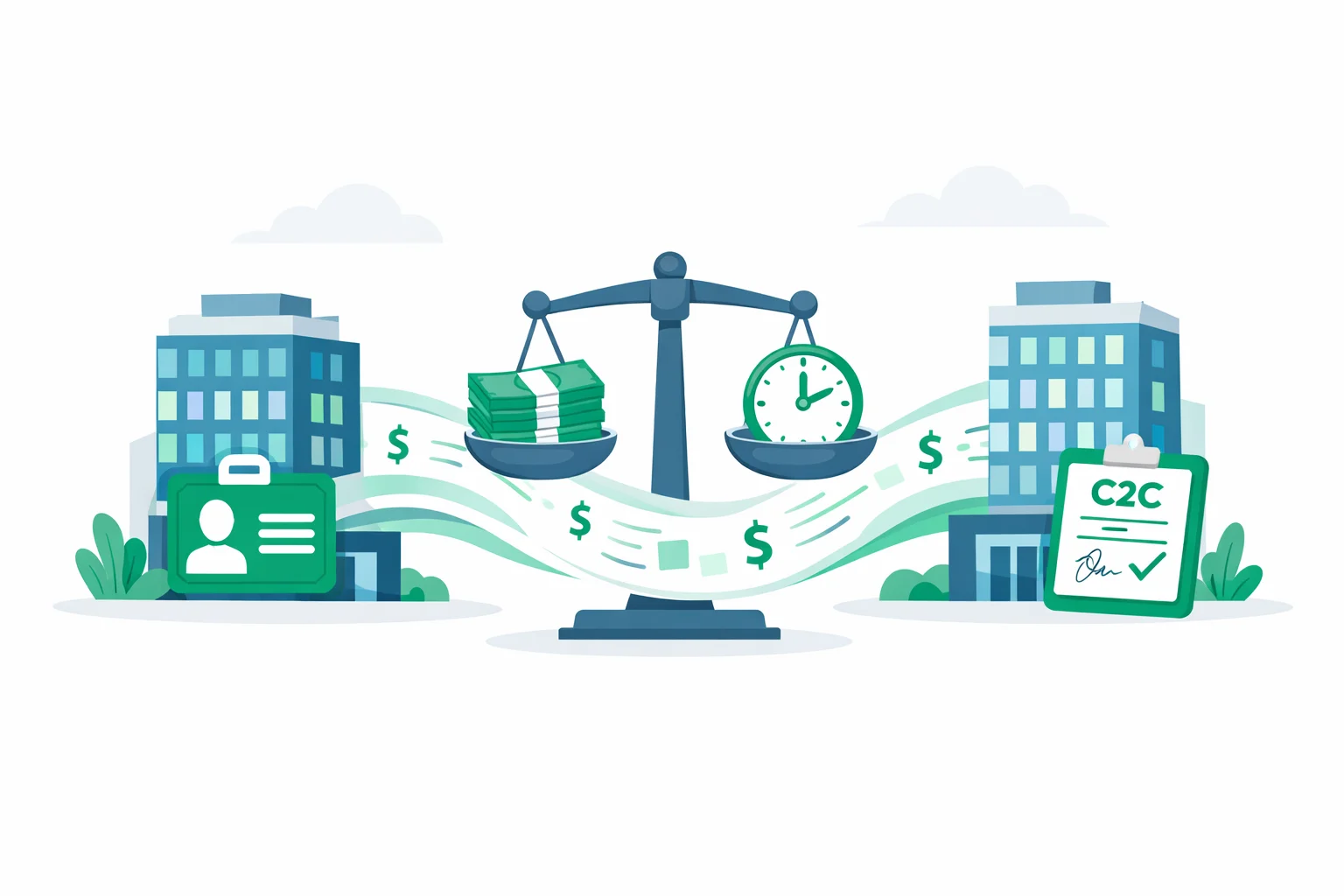
A corp to corp tax calculator helps contractors figure out exactly how much money they keep when billing through their own corporation instead of taking a W-2 salary. If a recruiter offers you $95/hour C2C and you're currently earning $120,000 as a full-time employee, the math isn't as simple as multiplying $95 by 2,000 hours. You need to account for self-employment taxes, health insurance premiums, lost employer benefits, and business expenses that eat into your gross revenue. The difference between a good C2C deal and a bad one often comes down to $10,000–$25,000 per year in hidden costs that most contractors don't calculate until tax season.
This article walks through the complete tax math behind C2C arrangements, compares them side-by-side with W-2 employment, and shows you the minimum hourly rate you need to break even. We'll use real 2025 tax brackets and payroll rates so you can make an informed decision before signing that contract.
How Corp-to-Corp Arrangements Work
In a C2C setup, you form your own business entity—typically an S-Corporation or single-member LLC—and invoice the client company (or their staffing agency) directly. Instead of receiving a W-2 with taxes already withheld, your corporation receives the full gross payment. You then handle all tax obligations yourself: quarterly estimated payments, self-employment or payroll taxes, health insurance, and retirement contributions.
The client saves money because they don't pay the employer share of FICA (7.65%), unemployment insurance, workers' comp, or benefits. That's why C2C rates are typically 30–50% higher than equivalent W-2 salaries—the premium compensates you for absorbing those costs yourself.
S-Corp vs LLC for C2C Contractors
Your entity choice has a significant tax impact. With an LLC filing Schedule C, you pay 15.3% self-employment tax on 92.35% of your entire net profit. With an S-Corporation, you pay yourself a "reasonable salary" and take the remaining profit as a distribution that's exempt from payroll taxes. On $190,000 net profit with an $80,000 salary, the S-Corp saves roughly $8,000–$12,000 in annual payroll taxes compared to an LLC. Use our corporate tax calculator to see the full entity-level comparison.
C2C vs W-2: A Worked Example
Let's compare a software developer earning $120,000/year as a W-2 employee against the same developer billing $95/hour C2C through an S-Corp. We'll assume 2,000 billable hours, a 5% state tax rate, and single filing status.
W-2 Employee Breakdown
| Item | Amount |
|---|---|
| Gross Salary | $120,000 |
| FICA (Employee: 6.2% SS + 1.45% Medicare) | −$9,180 |
| Federal Income Tax (after $15,750 standard deduction) | −$17,400 |
| State Income Tax (5%) | −$6,000 |
| Take-Home Pay | $87,420 |
The employer also pays $9,180 in FICA on your behalf plus an estimated $15,000 in benefits (health insurance, 401(k) match, PTO). Your total compensation package is really worth about $144,180—you just don't see most of it on your paycheck.
C2C Contractor Breakdown (S-Corp, $80K Salary)
| Item | Amount |
|---|---|
| Gross Revenue (2,000 hrs × $95) | $190,000 |
| Business Expenses (software, accounting, etc.) | −$8,000 |
| Health Insurance (individual plan) | −$7,200 |
| Retirement Contributions (Solo 401k) | −$6,000 |
| Net Profit | $168,800 |
| Payroll Tax on $80K salary (12.4% SS + 2.9% Medicare) | −$12,240 |
| Federal Income Tax (with QBI deduction) | −$21,800 |
| State Income Tax (5%) | −$8,100 |
| Take-Home Pay | $126,660 |
The C2C contractor nets roughly $39,000 more per year than the W-2 employee in this scenario. But subtract the $15,000 in employer benefits you no longer receive, and the real advantage is closer to $24,000. That's still a significant win—about $2,000/month more in your pocket.
Key Factors That Affect Your C2C Take-Home
Five variables determine whether a C2C arrangement beats W-2 employment. Small changes in any of these can swing the outcome by thousands of dollars per year. Understanding each one helps you negotiate better rates and structure your business for maximum tax efficiency.
- Billable hours: Full-time W-2 employees get paid for 2,080 hours including PTO and holidays. As a C2C contractor, unpaid time off, gaps between contracts, and bench time reduce your effective hours. Dropping from 2,000 to 1,800 billable hours at $95/hr costs you $19,000 in gross revenue.
- Health insurance costs: Employer-sponsored plans average $7,900/year for individual coverage (with the employer paying ~$6,600). As a C2C contractor, you pay the full $7,200–$14,400 yourself. Family plans run $20,000–$28,000. This is the single largest hidden cost in C2C arrangements.
- Entity type and salary split: An S-Corp with an $80,000 reasonable salary on $170,000 net profit saves about $9,500 in payroll taxes vs an LLC. But S-Corps cost $1,000–$3,000/year to maintain (payroll service, separate tax filing, state franchise fees). The savings justify the cost above roughly $80,000–$90,000 in net profit.
- State tax rates: Moving from California (13.3%) to Texas (0%) on $170,000 income saves over $22,000 in state taxes annually. Even a 5% vs 0% difference means $8,500/year. Use our state tax calculator to compare your specific situation.
- Business deductions: C2C contractors can deduct home office, equipment, software, professional development, mileage, and other business expenses that W-2 employees cannot. Every $1,000 in legitimate deductions saves $250–$370 in taxes depending on your bracket.
Finding Your Breakeven C2C Rate
The breakeven rate is the minimum C2C hourly rate that matches your W-2 take-home pay. A common rule of thumb says to multiply your W-2 hourly rate by 1.4–1.6, but the actual multiplier depends on your tax situation, expenses, and benefits.
For the $120,000 W-2 example above (take-home of $87,420), the breakeven C2C rate is approximately $65/hour assuming 2,000 billable hours, $21,200 in annual expenses (health insurance + business costs + retirement), and S-Corp entity structure. Anything above $65/hr puts more money in your pocket than the W-2 job.
Here's a quick reference for common W-2 salary levels. These assume single filing, 5% state tax, S-Corp structure, and $21,200 in annual C2C expenses:
| W-2 Salary | W-2 Take-Home | Breakeven C2C Rate | Rate for +$20K Gain |
|---|---|---|---|
| $80,000 | $60,500 | ~$52/hr | ~$65/hr |
| $100,000 | $73,800 | ~$59/hr | ~$73/hr |
| $120,000 | $87,400 | ~$65/hr | ~$80/hr |
| $150,000 | $105,200 | ~$75/hr | ~$92/hr |
| $200,000 | $134,800 | ~$93/hr | ~$112/hr |
Common Mistakes C2C Contractors Make
Contractors who switch from W-2 to C2C without doing the full math often face unpleasant surprises at tax time. These are the four most expensive mistakes we see, along with how much each one typically costs.
- Ignoring the employer benefits gap: A W-2 employee at $120,000 typically receives $12,000–$20,000 in employer-paid benefits (health insurance, 401(k) match, PTO, disability insurance). Contractors who compare only gross pay to gross revenue overestimate their C2C advantage by that entire amount. Always calculate your "total compensation equivalent" before comparing rates.
- Not making quarterly estimated payments: The IRS expects taxes paid throughout the year. If you owe more than $1,000 at filing time, you'll face an underpayment penalty of roughly 8% annually on the shortfall. On a $15,000 quarterly payment missed by 6 months, that's a $600 penalty. Set aside 25–35% of every invoice for taxes and pay quarterly estimated taxes on time.
- Setting S-Corp salary too low: Paying yourself $40,000 when comparable employees earn $90,000 invites an IRS audit. If the IRS reclassifies your distributions as wages, you'll owe back payroll taxes plus penalties—potentially $8,000–$15,000 on a $100,000 reclassification. Research salaries for your role on the Bureau of Labor Statistics Occupational Employment and Wage Statistics site.
- Forgetting bench time between contracts: Most C2C contractors have gaps between engagements—typically 2–6 weeks per year. At $95/hr, a 4-week gap costs $15,200 in lost revenue. Budget for at least 2 weeks of unpaid time annually, and keep a 3-month cash reserve for longer gaps.
When C2C Makes Sense (and When It Doesn't)
C2C contracting isn't automatically better than W-2 employment. The right choice depends on your income level, risk tolerance, and personal situation. Here's a practical decision framework based on common scenarios we see among IT contractors and consultants.
Choose C2C when:Your offered C2C rate is at least 40% above your W-2 hourly equivalent, you're comfortable managing your own taxes and benefits, you have consistent demand for your skills with minimal bench time, and your net profit exceeds $80,000 (the threshold where S-Corp savings justify the overhead). Most successful C2C contractors earn $100–$200+/hr in fields like software engineering, data science, and management consulting.
Stick with W-2 when: The C2C premium is under 30%, you need employer-sponsored health insurance for a family (saving $15,000–$25,000/year in premiums), you value PTO and job stability, or you're early in your career and benefit from mentorship and structured growth. Also consider that W-2 employeesqualify more easily for mortgages and loans—lenders prefer stable employment income over 1099/K-1 income.
Tax Optimization Tips for C2C Contractors
Once you've decided to go C2C, these strategies help you keep the maximum amount of your earnings. Each tip includes specific dollar impacts so you can prioritize which ones matter most for your situation.
- Max out your Solo 401(k): In 2025, you can contribute up to $23,500 as an employee plus 25% of net self-employment income as the employer, for a combined max of $70,000. At a 32% marginal rate, contributing $50,000 saves $16,000 in current-year taxes. This is the single most powerful tax shelter available to C2C contractors.
- Deduct health insurance above the line: Self-employed individuals can deduct 100% of health insurance premiums as an adjustment to income (not an itemized deduction). A $7,200 annual premium at a 24% bracket saves $1,728 in federal taxes alone.
- Track every deductible expense: Home office ($1,500 simplified deduction or actual costs), internet ($600–$1,200/year), professional development ($500–$3,000), accounting fees ($500–$2,000), and business travel. These add up to $3,000–$8,000 for most contractors. Use our profit calculator to model expense scenarios.
- Time your income strategically: If you expect lower income next year (career break, extended vacation), defer December invoices to January to shift income into a lower tax bracket. A $20,000 income shift from the 32% bracket to the 24% bracket saves $1,600.
- Elect S-Corp status before March 15: File Form 2553 within 75 days of forming your LLC (or by March 15 for the current tax year). Missing this deadline means paying full SE tax for the entire year—a potential $8,000–$15,000 cost on $150,000+ in profit.