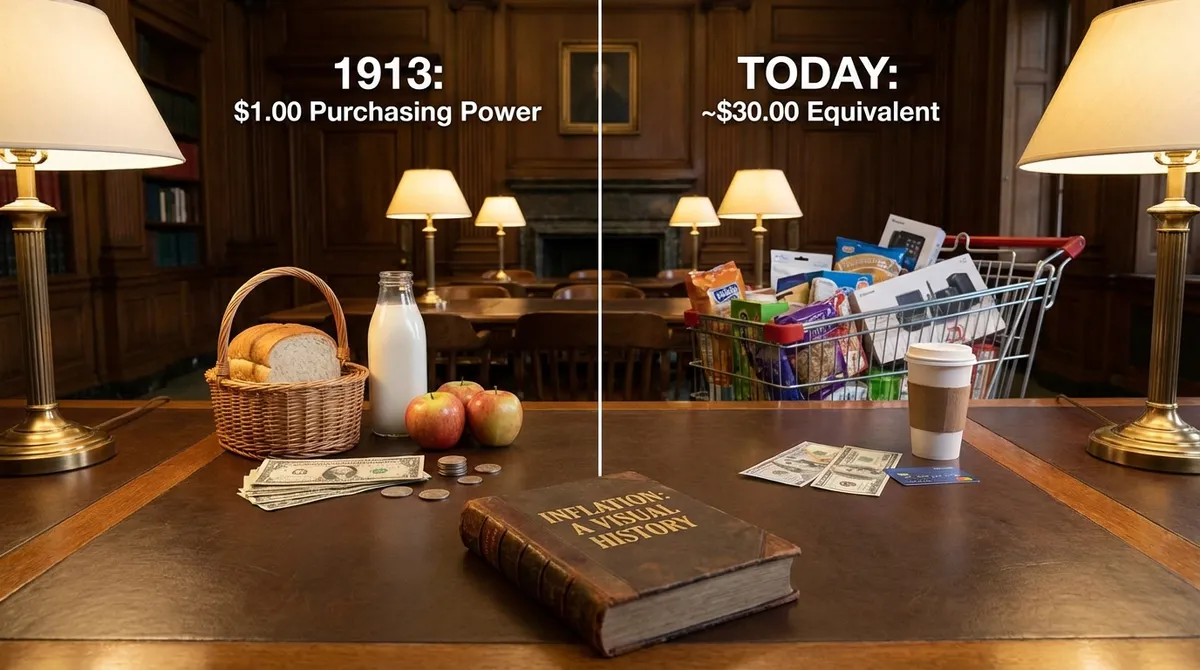
Understanding how the value of money changes over time is crucial for financial planning, historical analysis, and investment strategy. Our Inflation Calculator by Year uses official Consumer Price Index (CPI) data to accurately measure the purchasing power of the US dollar between any two years from 1913 to the present.
How to Use This Inflation Calculator
Calculating the historical value of money is straightforward with our tool. Follow these simple steps to see how inflation has impacted purchasing power over time:
- Enter the Amount: Input the dollar amount you want to adjust. This could be the price of a house, a salary, or the cost of a loaf of bread in the starting year.
- Select Start Year: Choose the year the amount is from. Our data goes back to 1913, the year the CPI was first officially tracked.
- Select End Year: Choose the target year you want to compare against. This is typically the current year, but you can compare any two historical years (e.g., 1950 vs. 1980).
- Review Results: The calculator will instantly display the adjusted value, the total cumulative inflation percentage, and the annualized inflation rate (CAGR).
Pro Tip: Reverse Calculation
How It Works: The Math Behind Inflation
Inflation calculations rely on the Consumer Price Index (CPI), which is a measure of the average change over time in the prices paid by urban consumers for a market basket of consumer goods and services. The Bureau of Labor Statistics (BLS) publishes this data monthly.
The Inflation Formula
To adjust a value for inflation, we use the ratio of the CPI in the target year to the CPI in the base year. The formula is:
Adjusted Value = Principal × (CPIEnd Year / CPIStart Year)
For example, if you want to know what $100 in 1980 is worth in 2024:
- CPI in 1980: 82.4
- CPI in 2024: 313.7 (estimated average)
- Calculation: $100 × (313.7 / 82.4) = $380.70
This means you would need approximately $380.70 in 2024 to buy the same amount of goods and services that $100 could buy in 1980.
Calculating Cumulative Inflation
Cumulative inflation represents the total percentage increase in prices over the entire period. It is calculated as:
Total Inflation % = ((CPIEnd Year - CPIStart Year) / CPIStart Year) × 100
Annualized Inflation Rate (CAGR)
The annualized inflation rate tells you the average rate at which prices increased per year during the selected period. This is often more useful than the total percentage for comparing different timeframes. We use the Compound Annual Growth Rate (CAGR) formula:
CAGR = ((CPIEnd Year / CPIStart Year)1/n - 1) × 100
Where n is the number of years between the start and end dates.
Historical Inflation Context
Understanding inflation requires looking at the historical context. The US economy has experienced periods of high inflation, low inflation, and even deflation. Here are some key eras:
The Great Inflation (1965-1982)
A period of sustained high inflation, peaking at over 14% in 1980. This era fundamentally changed how economists and policymakers approach monetary policy.
The Great Moderation (1982-2007)
Characterized by low volatility and stable inflation, typically averaging around 2-3%. This period ended with the 2008 financial crisis.
Post-COVID Inflation (2021-Present)
Supply chain disruptions and fiscal stimulus led to a spike in inflation, reaching 40-year highs in 2022 before beginning to cool down.
Inflation Trends by Decade
Analyzing inflation by decade provides valuable insights into the economic history of the United States. Each era was defined by unique economic challenges and monetary policies.
1910s - 1920s: War and Roaring Twenties
The decade began with stable prices, but World War I caused significant inflation, with rates peaking above 20% in 1917. The 1920s, known as the "Roaring Twenties," saw a period of deflation and economic prosperity before the stock market crash of 1929 triggered the Great Depression.
1930s: The Great Depression
This decade was characterized by severe deflation. Prices dropped significantly as demand collapsed. The US Inflation Calculator shows that a dollar in 1933 had significantly more purchasing power than in 1929, simply because goods were cheaper due to the economic crisis.
1940s: World War II
The war effort led to massive government spending and resource rationing. Inflation spiked again, particularly after price controls were lifted in 1946. This period demonstrated how fiscal stimulus and supply constraints can drive up prices.
1970s: Stagflation
The 1970s were infamous for "stagflation"—a combination of stagnant economic growth and high inflation. Oil price shocks and loose monetary policy contributed to double-digit inflation rates. This era serves as a cautionary tale for central bankers today. You can use our Inflation Rate Calculator to see the dramatic year-over-year jumps during this period.
1990s - 2000s: The Great Moderation
Following the aggressive interest rate hikes of the early 1980s, inflation stabilized. The 1990s and 2000s saw relatively low and stable inflation, aiding long-term economic planning and investment. This stability allowed for the growth of financial instruments like those calculated with our Investment Calculator.
2020s: Pandemic and Recovery
The COVID-19 pandemic brought a new wave of inflation, driven by supply chain bottlenecks and unprecedented fiscal stimulus. While rates have since moderated, the price level remains permanently higher than pre-pandemic levels.
Why Does Inflation Matter?
Inflation is often called the "silent thief" because it erodes the purchasing power of your money without you necessarily noticing it day-to-day.
- Savings: If your savings account interest rate is lower than the inflation rate, you are effectively losing money in real terms.
- Wages: If your salary doesn't increase at the same rate as inflation, your standard of living decreases because you can afford fewer goods.
- Investments: Investors must aim for returns that exceed inflation to grow their real wealth. This is why many turn to the stock market or real estate, which historically outpace inflation over long periods.
- Debt: Inflation can actually benefit borrowers. If you have a fixed-rate mortgage, you are paying back the loan with dollars that are worth less than when you borrowed them.
Frequently Asked Questions
Practical Applications of Historical Inflation Data
Understanding historical inflation data has numerous real-world applications that can help you make smarter financial decisions. Whether you're planning for retirement, negotiating a salary, or evaluating investment returns, historical CPI data provides essential context.
Retirement Planning:When estimating how much money you'll need in retirement, it's crucial to account for inflation. A comfortable income today may not be sufficient in 20 or 30 years. By analyzing historical inflation trends, financial planners typically use a 2-3% annual inflation assumption for long-term projections, though periods like the 1970s remind us that higher rates are possible.
Salary Negotiations: When evaluating a raise or job offer, consider whether the increase keeps pace with inflation. A 2% raise in a year with 5% inflation actually represents a 3% decrease in purchasing power. Historical data helps you set realistic expectations for compensation growth.
Investment Analysis: When calculating historical investment returns, always consider the real (inflation-adjusted) return. A stock that returned 10% annually during a period with 8% inflation only provided 2% real growth. This perspective helps you evaluate different asset classes and time periods more accurately.
Related Tools
If you found this calculator useful, you might also be interested in our other financial tools:
- CPI Calculator: Calculate inflation using specific CPI index values.
- Future Value Calculator: Project the future value of investments with compound interest.
- Purchasing Power Calculator: See how much your money is really worth.